
In brief
The UAE Federal Tax Authority has issued the Top-up Tax Guide – Scope and Registration | TTGREG1, providing detailed guidance on the scope and registration requirements for the UAE’s Top-up Tax regime applicable to certain Multinational Enterprise Groups.
The guide is relevant for UAE entities that are part of large multinational groups, particularly where the group has consolidated annual revenue of EUR 750 million or more in at least two of the four Fiscal Years preceding the tested Fiscal Year.
The UAE Top-up Tax regime forms part of the UAE’s implementation of the OECD/G20 Pillar Two global minimum tax framework. The UAE has introduced a Qualified Domestic Minimum Top-up Tax, commonly referred to as QDMTT, for Fiscal Years beginning on or after 1 January 2025.
For affected multinational groups, the key question is no longer only whether the UAE entity is registered for Corporate Tax. A separate assessment is required to determine whether the entity is within scope of Top-up Tax registration, whether a Domestic Designated Filing Entity should be appointed, and whether Pillar Two information reporting obligations may arise.
Executive summary
The UAE Top-up Tax regime is targeted at large multinational groups, not ordinary standalone UAE businesses.
The FTA guide confirms that the regime applies to UAE-located Constituent Entities of an in-scope MNE Group where the group meets the consolidated revenue threshold. The guide also explains how to identify Entities in scope, how Permanent Establishments are treated, when Joint Ventures and Minority-Owned Constituent Entities may be captured, and when certain Entities are not required to register.
A key practical point is that registration for Corporate Tax and registration for Top-up Tax are not the same. An Entity may already have a Corporate Tax TRN but may still need a separate Pillar Two Top-up Tax TRN. Similarly, an Entity that is not required to register for Corporate Tax may still need to register for Top-up Tax if it falls within the QDMTT charging provisions.
The registration deadline is especially important. For a Fiscal Year ending before 30 April 2026, the registration application should be submitted by 30 November 2026. For other cases, registration should generally be completed within seven months from the end of the first Fiscal Year in which the Entity is in scope.
Failure to register within the applicable timeline may result in an administrative penalty of AED 10,000.
In detail
What is the UAE Top-up Tax?
The UAE Top-up Tax is part of the UAE’s implementation of the global minimum tax framework for large multinational groups.
Under the OECD/G20 Pillar Two framework, large multinational enterprise groups are generally expected to be subject to a minimum effective tax rate of 15% in each jurisdiction where they operate. The UAE has implemented a domestic minimum top-up tax mechanism to preserve UAE taxing rights over profits earned by in-scope entities located in the UAE.
The UAE regime is referred to in the FTA guide as the QDMTT Legislation, being the rules introduced under Cabinet Decision No. 142 of 2024 on the Imposition of Top-up Tax on Multinational Enterprises.
Why was the UAE Top-up Tax introduced?
The FTA guide explains that the UAE introduced the QDMTT as part of its commitment to implement the OECD/G20 two-pillar solution and to align its tax framework with global standards.
A domestic top-up tax allows the UAE to collect the relevant Top-up Tax on UAE profits before another jurisdiction applies an Income Inclusion Rule or Undertaxed Profits Rule. This is important because it helps protect the UAE tax base and provides greater certainty to in-scope multinational groups operating in the UAE.
The FTA guide also notes that the UAE currently does not have an Income Inclusion Rule or Undertaxed Profits Rule.
Who is in scope?
The QDMTT Legislation applies to Constituent Entities located in the UAE that are members of an in-scope MNE Group.
A group will generally be in scope where both of the following conditions are met:
- MNE Group condition
The group must operate through at least one Entity or Permanent Establishment outside the jurisdiction of the Ultimate Parent Entity. 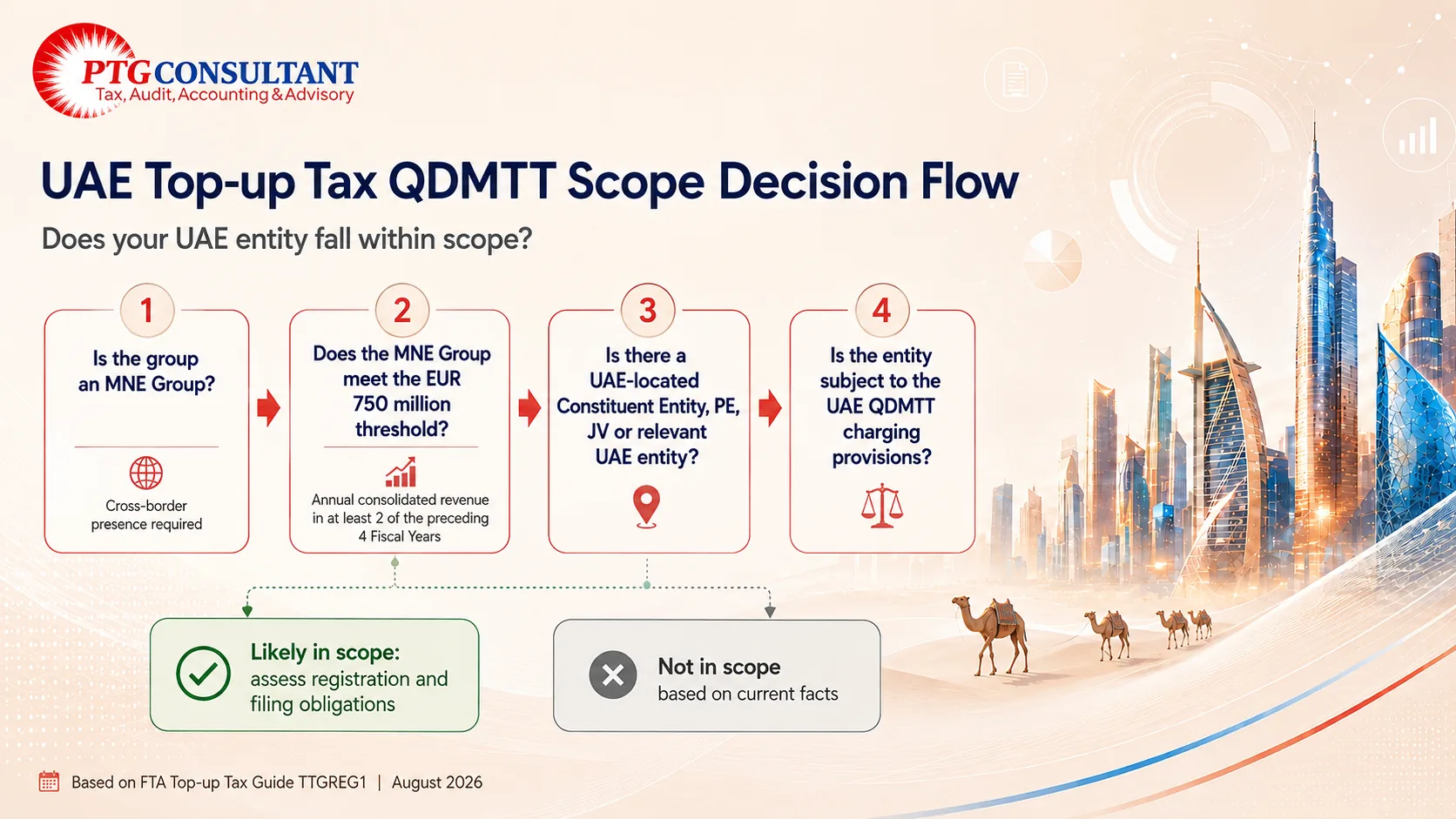
- Consolidated revenue threshold condition
The MNE Group must have annual revenue of EUR 750 million or more in the consolidated financial statements in at least two of the four Fiscal Years immediately preceding the tested Fiscal Year. 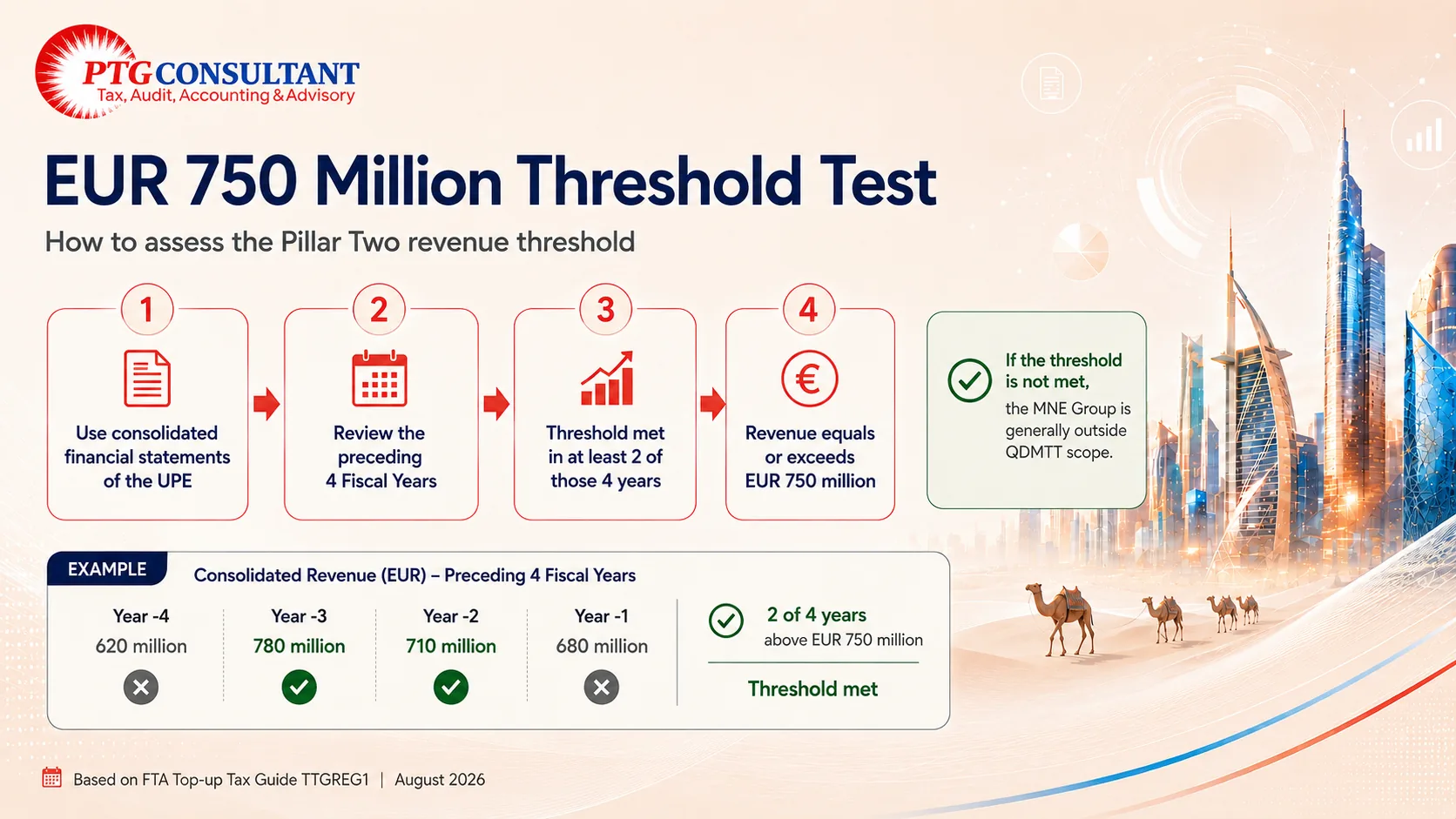
This means a purely domestic UAE group, even a large one, should not automatically fall within scope merely because it has high revenue. The cross-border element is fundamental to the definition of an MNE Group.
Which UAE entities may be captured?
The guide identifies several categories that may fall within the UAE Top-up Tax charging provisions.
These include:
- Constituent Entities located in the UAE during the Fiscal Year;
- Constituent Entities located in the UAE that are members of a Minority-Owned Subgroup;
- Joint Ventures and JV Subsidiaries located in the UAE;
- certain Stateless Constituent Entities created under UAE law that are Reverse Hybrid Entities.
The analysis therefore requires more than simply identifying UAE subsidiaries. Groups must review the full structure, including branches, Permanent Establishments, flow-through arrangements, minority-owned structures and joint ventures.
What is a Constituent Entity?
A Constituent Entity generally includes an Entity that is part of the group, including an Entity whose financial results are consolidated on a line-by-line basis in the consolidated financial statements of the Ultimate Parent Entity.
The guide also explains that Entities excluded from consolidated financial statements solely due to size, materiality or held-for-sale classification may still be treated as part of the group for QDMTT purposes.
Permanent Establishments may also be treated as separate Constituent Entities.
This is a key difference from normal Corporate Tax registration thinking. For QDMTT purposes, the group consolidation analysis and Pillar Two classification may drive the outcome.
Permanent Establishments and branches
Permanent Establishments require specific review.
A UAE Permanent Establishment of a foreign main entity may be treated as a Constituent Entity located in the UAE. In some cases, different branches or business presences may be treated as separate Permanent Establishments for QDMTT purposes, depending on the facts.
The guide confirms that a Permanent Establishment located in the UAE and subject to Top-up Tax is required to register with the FTA, unless an exception applies.
Joint Ventures and JV Subsidiaries
Joint Ventures and JV Subsidiaries can also be relevant.
The guide explains that a Joint Venture and its JV Subsidiaries located in the UAE may be subject to Top-up Tax. This can apply even where the Joint Venture is not consolidated on a line-by-line basis but is reported using the equity method, provided the relevant ownership and Pillar Two conditions are met.
Where an in-scope MNE Group has both a Domestic Main Group and a Domestic JV Group, separate compliance and registration analysis may be required.
Minority-Owned Constituent Entities
The guide also addresses Minority-Owned Constituent Entities.
A Minority-Owned Constituent Entity is broadly a Constituent Entity where the Ultimate Parent Entity has a direct or indirect ownership interest of 30% or less, but the entity is still consolidated because the UPE has controlling interest.
This is important because a low ownership percentage does not necessarily remove the entity from the Top-up Tax analysis if control and consolidation are present.
Flow-through Entities, Reverse Hybrids and UAE partnerships
The FTA guide includes detailed rules for flow-through entities, tax transparent entities and reverse hybrid entities.
This may be particularly relevant for UAE partnerships, trusts, unincorporated partnerships and similar arrangements that prepare separate financial accounts.
For UAE businesses, the practical point is that Pillar Two classification may differ from ordinary legal form. A UAE arrangement that is not a normal company may still be treated as an Entity for QDMTT purposes if it prepares separate financial accounts.
Which entities are not subject to Top-up Tax?
The guide identifies certain entities that are not subject to Top-up Tax.
These include:
- Excluded Entities;
- Investment Entities located in the UAE;
- certain Stateless Constituent Entities that are not Reverse Hybrid Entities.
Excluded Entities may include, subject to conditions, Governmental Entities, International Organisations, Non-profit Organisations, Pension Funds, Investment Funds that are UPEs, and Real Estate Investment Vehicles that are UPEs.
However, care is required. If an election is made not to treat an Entity as an Excluded Entity, that Entity may become subject to Top-up Tax and may be required to register.
Registration for UAE Top-up Tax
Who must register?
Any Entity that is subject to Top-up Tax under the QDMTT Legislation is required to register with the FTA.
This includes a Domestic Designated Filing Entity, if one is appointed.
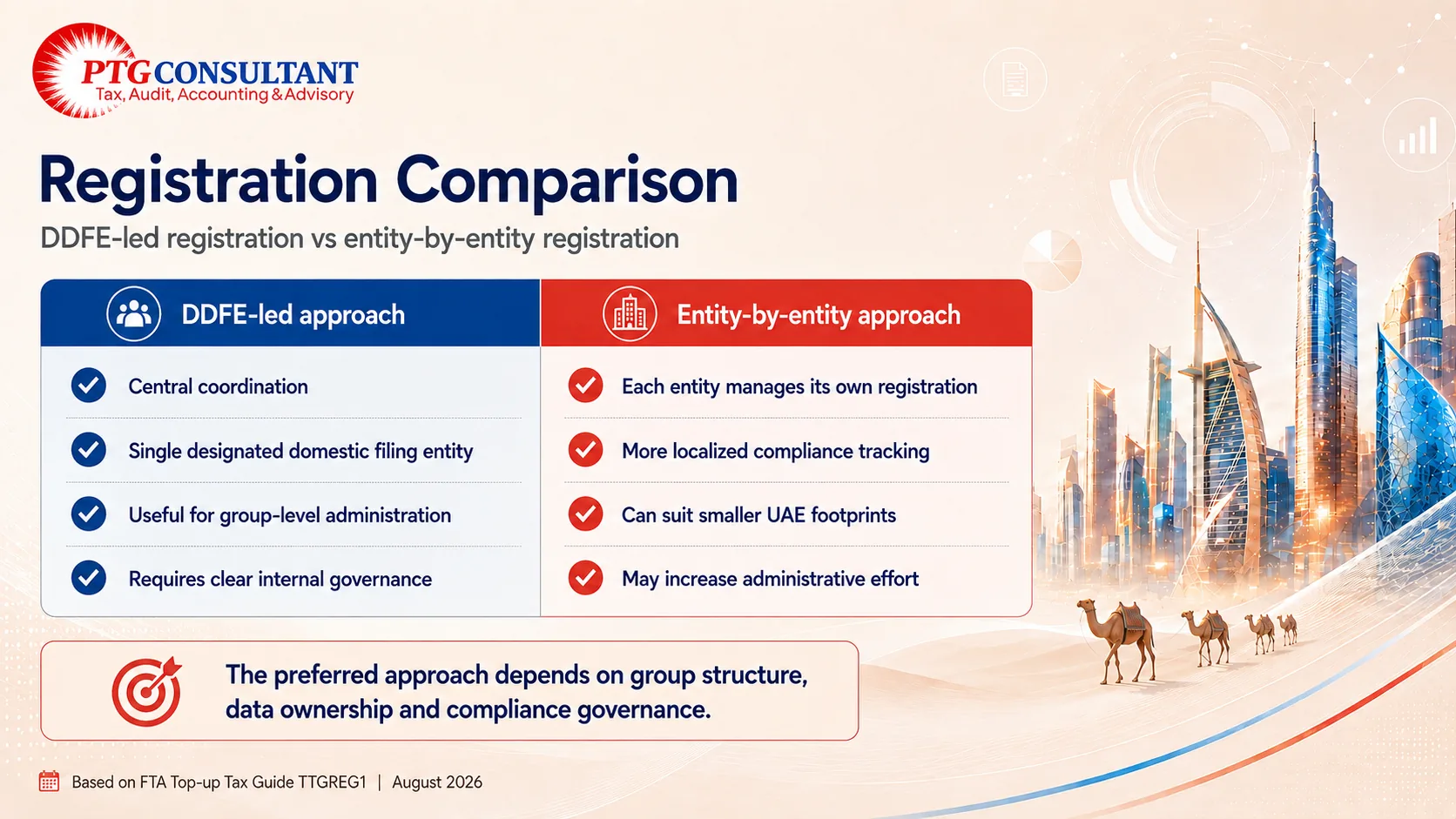
Registration may be completed either:
- Entity-by-Entity, where each in-scope UAE Entity submits its own registration application; or
- through a Domestic Designated Filing Entity, where the DDFE registers on behalf of the relevant Domestic Group.
What is a DDFE?
A Domestic Designated Filing Entity is an Entity appointed to file the Top-up Tax Return and pay Top-up Tax on behalf of members of the relevant Domestic Group.
The DDFE approach can reduce the administrative burden for multinational groups with multiple UAE entities. However, the appointment should be carefully documented and authorised.
Where a DDFE is appointed, it should submit the registration application on behalf of the relevant group members and may receive a group-level Pillar Two Top-up Tax TRN in addition to the TRNs issued to individual Entities.
Corporate Tax registration is not enough
One of the most important practical messages in the guide is that Top-up Tax registration is separate from Corporate Tax registration.
An Entity subject to Top-up Tax must register for Top-up Tax even if it is already registered for Corporate Tax.
Where the Entity is already registered with the FTA for another tax type, the Pillar Two Top-up Tax TRN should include the same Tax Identification Number, being the first 10 digits of the existing TRN.
This means groups should not assume that existing Corporate Tax registration automatically satisfies Top-up Tax registration requirements.
Registration where Top-up Tax is deemed to be zero
The guide also clarifies an important point: registration may still be required even where the Top-up Tax is deemed to be zero.
This may occur where provisions such as the de-minimis exclusion, Transitional CbCR Safe Harbour, Simplified Calculations Safe Harbour or initial phase of international activities apply.
In other words, a zero Top-up Tax outcome does not automatically mean there is no registration requirement.
Entities not required to register
Entities that are not subject to the charging provision of the QDMTT Legislation are not required to register for QDMTT purposes.
Examples may include:
- Excluded Entities;
- Investment Entities located in the UAE;
- stateless Permanent Establishments;
- stateless Tax Transparent Entities.
Each case should be assessed based on the group structure, location rules and entity classification.
Registration timelines
The registration deadlines are a key risk area.
For a Fiscal Year ending before 30 April 2026, the registration application should be submitted to the FTA on or before 30 November 2026.
For all other cases, the registration application should generally be submitted within seven months from the end of the first Fiscal Year in which the Entity is in scope of the QDMTT Legislation.
Where an in-scope MNE Group acquires a UAE Entity, the acquired Entity should also be reviewed for registration within the applicable timeline.
Administrative penalty
An administrative penalty of AED 10,000 applies where an Entity fails to submit a Top-up Tax registration application within the relevant timeline.
Where a DDFE fails to submit a registration application within the prescribed timeline, the AED 10,000 penalty may apply in respect of each Entity for which the DDFE failed to submit the registration application.
This makes group-level governance and registration tracking essential.
Registration process on EmaraTax
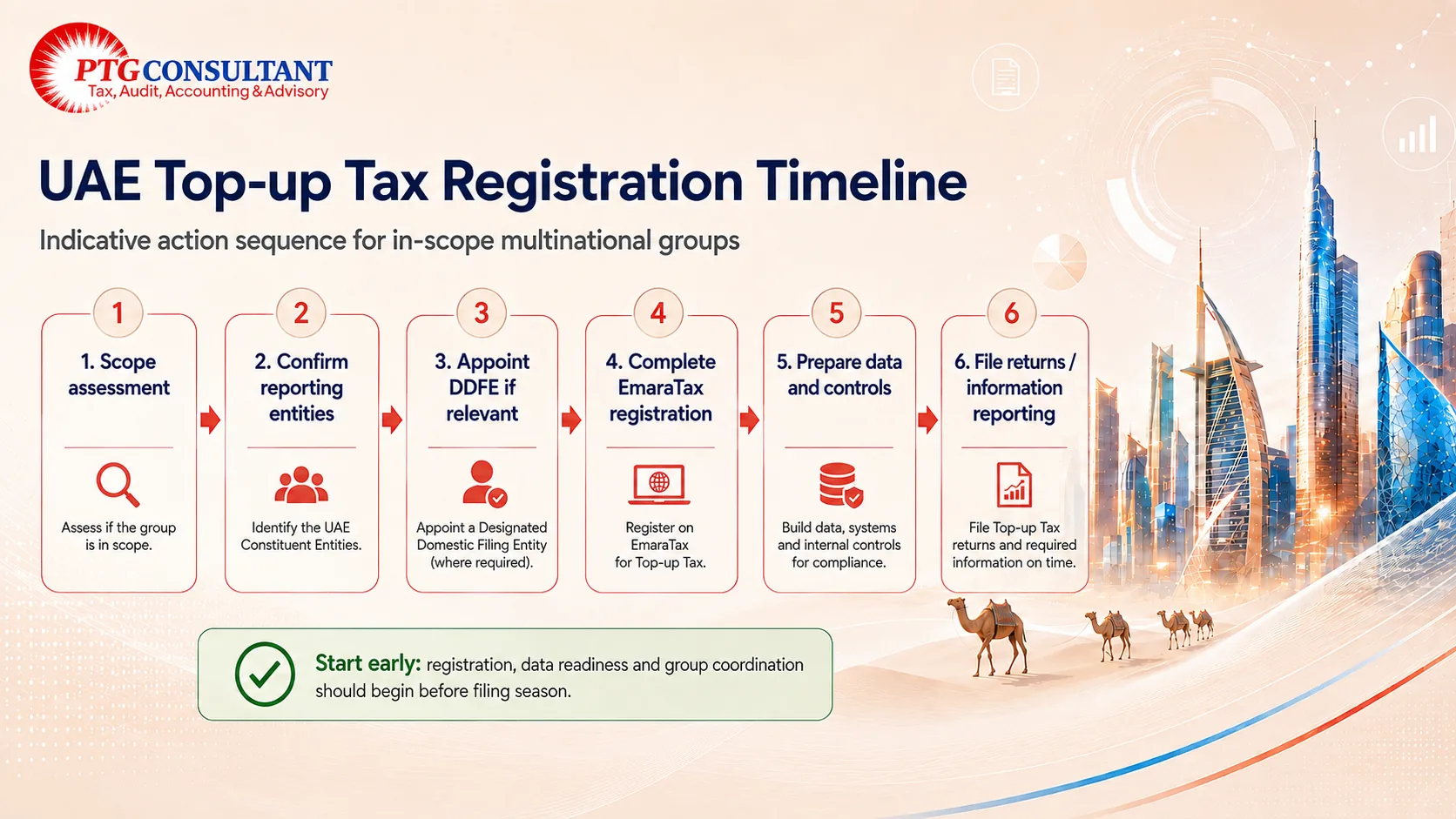
The registration application should be submitted through the EmaraTax portal.
Where the Entity is already registered for another UAE tax type, it should use the same Taxable Person profile on EmaraTax to register for Top-up Tax.
Where the Entity is not already registered with the FTA, a Taxable Person profile and Tax Identification Number must first be created before Top-up Tax registration can be completed.
The FTA may request additional information before approving the application. Once approved, the FTA issues a Pillar Two Top-up Tax TRN.
Documentation required
The guide identifies certain supporting documents for Top-up Tax registration.
These include:
- documents verifying the name and TIN of the Ultimate Parent Entity, where the UPE is located outside the UAE;
- documents verifying the name and TIN of the Designated Filing Entity, where applicable and where located outside the UAE;
- documents providing an overview of the corporate structure of the MNE Group.
The FTA may request further documents where needed.
Where a DDFE is appointed, each Entity represented by the DDFE must authorise the appointment. This can be done through the EmaraTax portal or through signed letters of authorisation uploaded with the registration application.
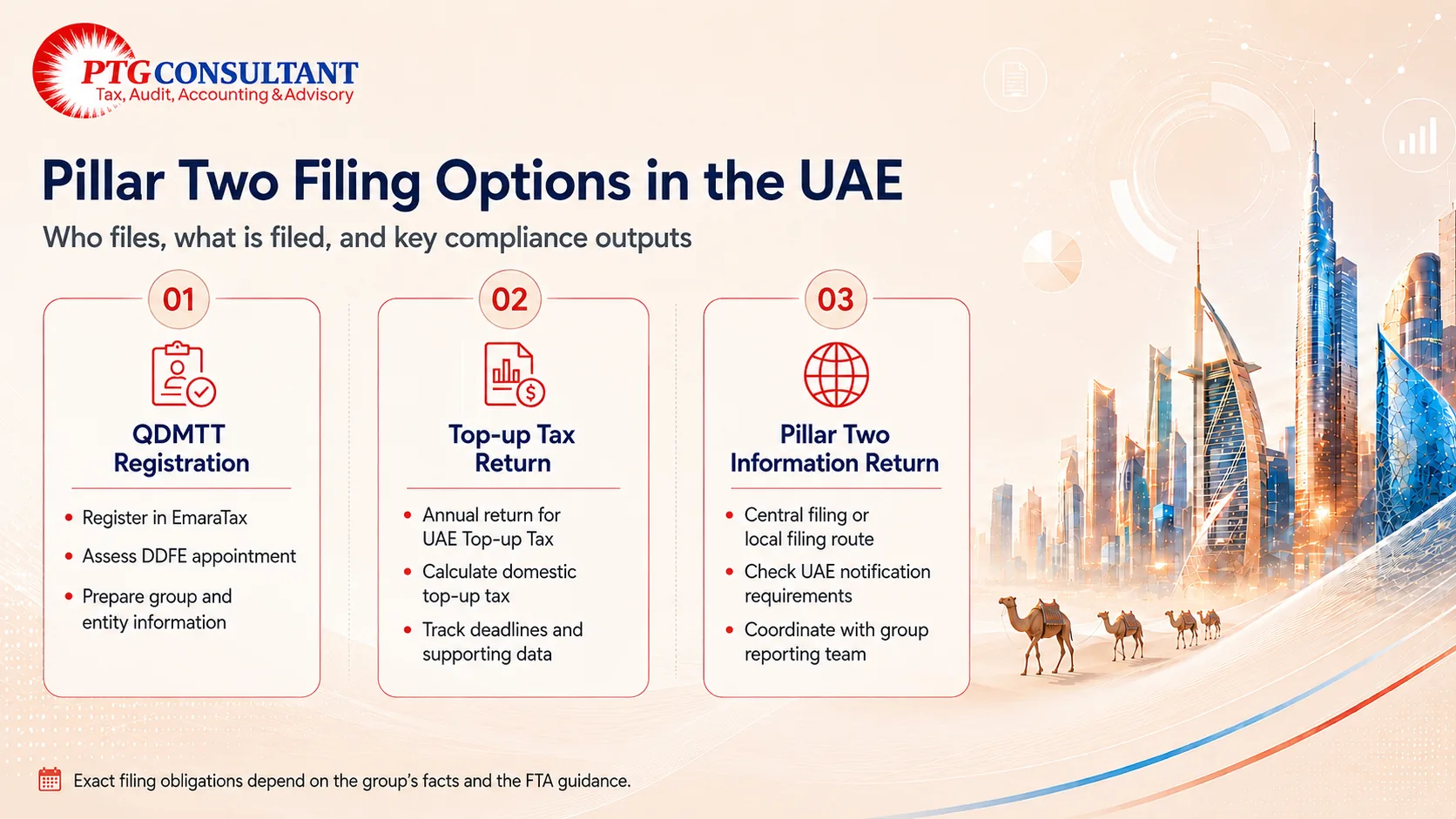
Pillar Two Information Return
The guide also links Top-up Tax registration to Pillar Two Information Return obligations.
The Entity that will file the Pillar Two Information Return should be identified to the FTA at the time of registration.
The guide refers to several filing options, including:
- filing by each relevant UAE Constituent Entity;
- filing by a Designated Local Entity on behalf of UAE entities;
- filing by the UPE in a jurisdiction with a Qualifying Competent Authority Agreement with the UAE;
- filing by a Designated Filing Entity in a jurisdiction with a Qualifying Competent Authority Agreement with the UAE.
A Designated Local Entity is different from a DDFE. The Designated Local Entity is responsible for filing the Pillar Two Information Return, while the DDFE has broader compliance responsibilities under the QDMTT framework. In some cases, the same UAE Entity may be appointed to perform both roles.
Practical impact for UAE businesses
The new guide is particularly important for:
- UAE subsidiaries of large multinational groups;
- UAE-headquartered groups with foreign subsidiaries or foreign Permanent Establishments;
- foreign groups operating in the UAE through branches or Permanent Establishments;
- groups with UAE joint ventures or JV subsidiaries;
- groups with minority-owned UAE entities that are consolidated;
- UAE flow-through entities, partnerships, trusts or similar arrangements with cross-border ownership;
- groups involved in acquisitions, mergers or demergers.
For ordinary UAE companies that are not part of a large MNE Group, the guide may have limited direct application. However, UAE entities with foreign shareholders or group companies should still check whether they are part of a consolidated multinational group meeting the EUR 750 million threshold.
Actions to consider
Affected groups should consider taking the following steps:
- Identify whether the UAE Entity is part of an MNE Group.
- Review the consolidated revenue threshold for the four preceding Fiscal Years.
- Identify the Ultimate Parent Entity and the consolidated financial statements used for testing.
- Map all UAE-located Constituent Entities, Permanent Establishments, Joint Ventures and JV Subsidiaries.
- Determine whether any UAE Entities are Excluded Entities, Investment Entities or stateless entities.
- Decide whether registration should be Entity-by-Entity or through a DDFE.
- Prepare the corporate structure chart and supporting documents.
- Identify whether a Designated Local Entity will file the Pillar Two Information Return.
- Confirm the registration deadline based on the relevant Fiscal Year.
- Maintain internal documentation supporting the scope and registration analysis.
How PTG Consultant L.L.C can support
PTG Consultant L.L.C can support UAE businesses and multinational groups with:
- UAE Top-up Tax scope assessment;
- QDMTT registration review;
- EUR 750 million threshold analysis;
- UAE Constituent Entity mapping;
- Permanent Establishment and branch classification;
- DDFE and Designated Local Entity assessment;
- EmaraTax registration support;
- documentation review and group structure mapping;
- Pillar Two Information Return readiness;
- coordination with finance, tax and group reporting teams.
Before submitting a registration application, multinational groups should perform a technical review to ensure the registration position is aligned with the FTA guide, the QDMTT Legislation, and the group’s consolidated financial reporting structure.
Conclusion
The FTA’s Top-up Tax Guide on Scope and Registration represents an important compliance development for large multinational groups operating in the UAE.
The regime is not a general tax increase for all UAE companies. It is a targeted Pillar Two compliance framework for in-scope multinational enterprise groups meeting the relevant threshold and entity classification rules.
The most important practical message is that affected groups should not wait until the Top-up Tax Return stage. Scope analysis, registration mapping, DDFE appointment, documentation and Pillar Two reporting responsibility should be reviewed early.
For in-scope groups, timely registration is critical to avoid administrative penalties and to ensure UAE Top-up Tax compliance is properly aligned with global Pillar Two reporting.
Official source basis
This article has been prepared with reference to:
- Federal Tax Authority – Top-up Tax Guide: Scope and Registration | TTGREG1 | August 2026
- Cabinet Decision No. 142 of 2024 on the Imposition of Top-up Tax on Multinational Enterprises
- Federal Decree-Law No. 47 of 2022 on the Taxation of Corporations and Businesses, as amended
- Ministerial Decision No. 96 of 2026 on OECD Commentary and Agreed Administrative Guidance
- Ministerial Decision No. 133 of 2026 on entities required to file the Pillar Two Information Return
- FTA Decision No. 12 of 2026 on registration and deregistration requirements for Top-up Tax
Disclaimer
This article is for general information only and should not be treated as legal, regulatory, accounting or tax advice. The application of UAE Top-up Tax depends on the specific group structure, consolidated financial statements, location of entities, ownership arrangements, Pillar Two classification and applicable UAE legislation. Professional advice should be obtained before determining registration obligations or submitting applications to the FTA.