
How to Apply for UAE Tax Residency Certificate (TRC) in 2026: Step-by-Step Guide with EmaraTax
Learn how to apply for the UAE Tax Residency Certificate (TRC) through EmaraTax in 2026. Understand Cabinet Decision No. 85 of 2022, Ministerial Decision No. 27 of 2023, TPGTR1 (October 2024), and the latest UAE tax residency rules for individuals and companies.
What Is UAE Tax Residence and Why It Matters in 2026
In today’s globally connected economy, determining UAE tax residence is crucial for individuals and businesses seeking tax clarity, compliance, and treaty benefits. The UAE Tax Residency Certificate (TRC), issued by the Federal Tax Authority (FTA), is the official proof that a person or entity qualifies as a resident person under UAE tax law.
With the introduction of Corporate Tax and enhanced Double Tax Treaty (DTA) frameworks, the TRC has become more than a formality—it’s a gateway to lower global taxes and legal certainty. Whether you’re a salaried individual, freelancer, or multinational corporation, obtaining a UAE TRC can help you avoid double taxation and strengthen your cross-border tax position.
Key Legal Framework for UAE Tax Residency: Updated Rules (2024–2026)
The UAE’s tax residency landscape is governed by several key regulations that came into effect between 2022 and 2024, ensuring alignment with international standards such as the OECD’s tax residency principles.
Also note: the Corporate Tax regime is established under Federal Decree-Law No. 47 of 2022 on the Taxation of Corporations and Businesses, which defines “Resident Person” for corporate tax purposes and interacts with domestic tax residency rules. Read the Decree-Law (MoF PDF)
Cabinet Decision No. 85 of 2022: Core UAE Tax Residency Definition
This decision laid the foundation for who qualifies as a tax resident in the UAE, distinguishing between natural persons (individuals) and juridical persons (companies). It introduced the 183-day and 90-day tests for individuals and defined effective management and control (EMC) as the determinant for companies. Cabinet Decision No. 85 of 2022
Ministerial Decision No. 27 of 2023: 90-Day and 183-Day Tests
Under the Ministerial decision No. 27 of 2023:
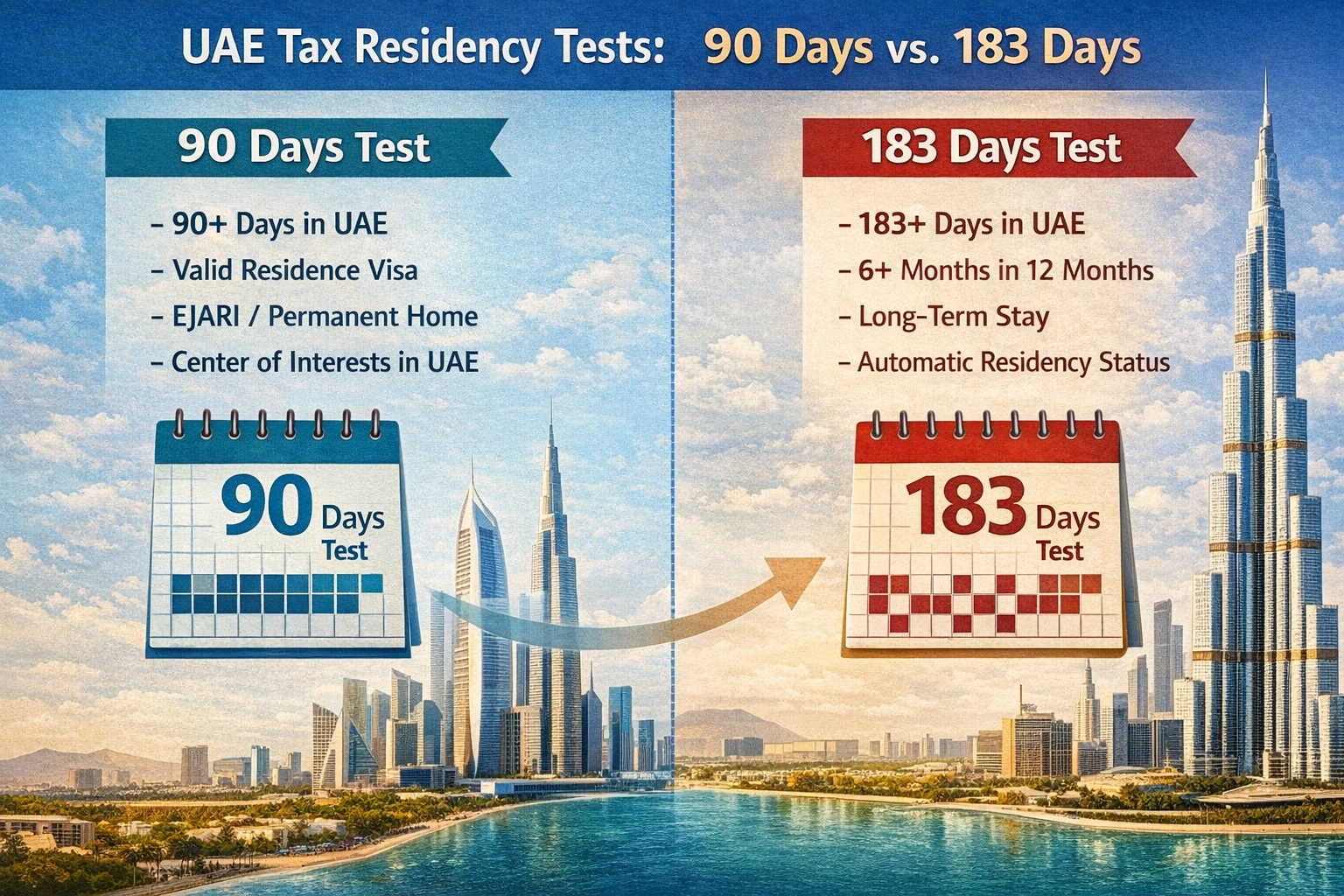
A natural person is tax resident if they spend 183 days or more in the UAE during a 12-month period.
Alternatively, if the person spends 90 days or more and maintains a permanent place of residence or has their center of financial and personal interests in the UAE, they may also qualify.
Ministerial Decision No. 247 of 2023: TRC Issuance Procedures
This decision established the FTA’s framework for issuing TRCs. It also connected TRC applications to the EmaraTax portal, where applicants submit evidence, pay fees, and track progress. Ministerial Decision No. 247 of 2023
Understanding the UAE Tax Residency Tests
UAE Tax Residency 183-Day Test
This is the simplest route to qualification. If you reside in the UAE for 183 days or more in a 12-month period, you are deemed tax resident. This test primarily applies to long-term residents and employees with valid residence permits.
UAE Tax Residency 90-Day Test
For those spending 90 days or more in the UAE, qualification depends on additional factors like:
Owning or renting a permanent home (EJARI-registered tenancy).
Maintaining a residence visa.
Having the centre of financial and personal interests in the UAE.
Permanent Place of Residence and Centre of Interests
To prove this, individuals must present EJARI contracts, utility bills, or salary certificates—all forming part of a strong TRC evidence pack.
Treaty Tax Residency and DTA Tie-Breaker Rules Explained
Under Double Taxation Agreements (DTAs), if a person qualifies as tax resident in two countries, tie-breaker rules determine their actual tax residence based on:
Permanent home availability
Vital interests (family, business)
Habitual abode
Nationality
Mutual agreement between tax authorities
For companies, the Effective Management and Control (EMC) test—often linked to where key decisions are made—determines residency.
How to Apply for UAE Tax Residency Certificate (TRC) via EmaraTax
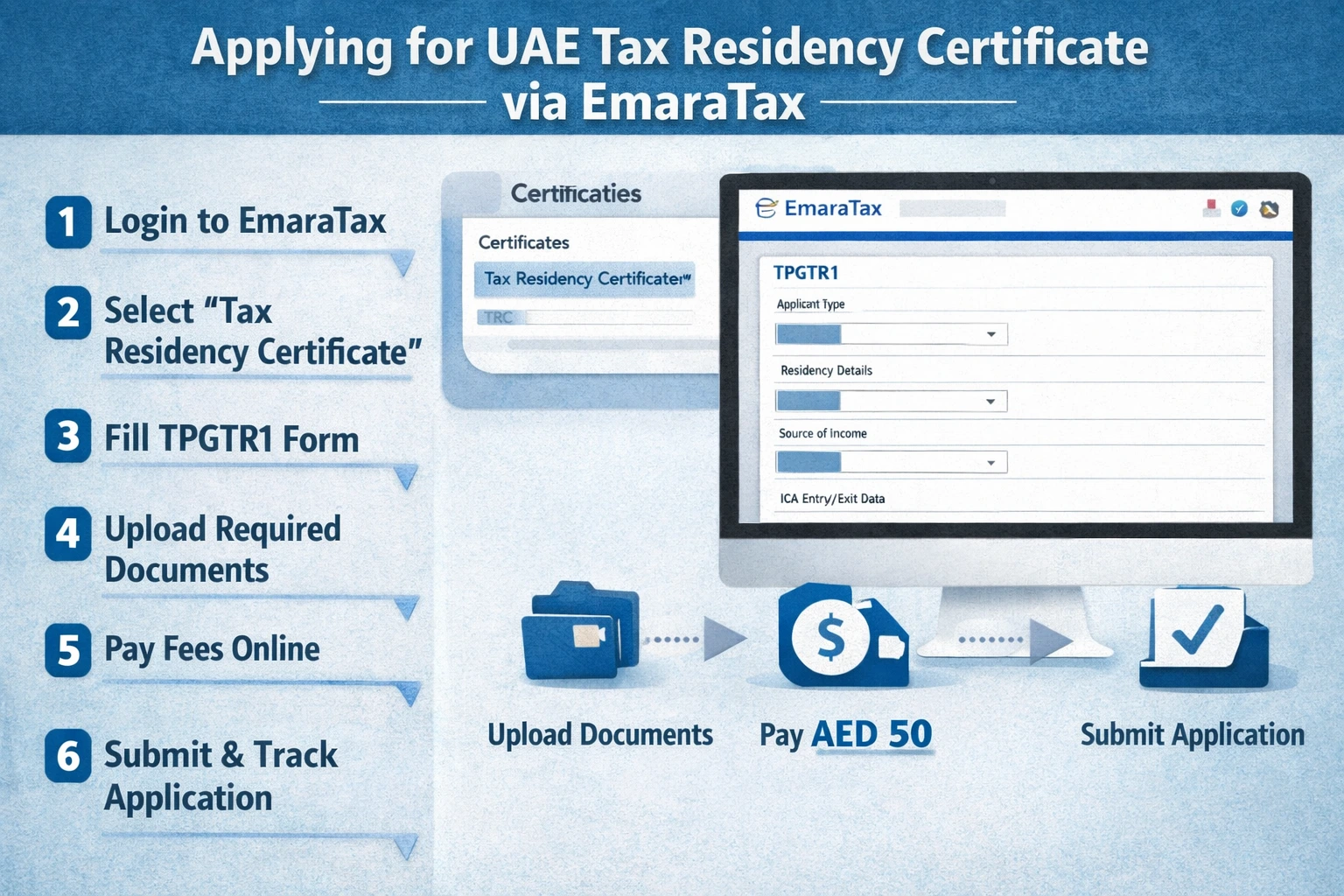
The UAE Tax Residency Certificate (TRC) application process has been streamlined through the EmaraTax portal, operated by the Federal Tax Authority (FTA). Whether you are an individual, freelancer, or company, understanding the step-by-step process ensures a smooth and rejection-proof submission.
Step-by-Step Guide to UAE TRC Application in EmaraTax Portal
Follow these simple steps to apply for your TRC in 2026:
Access the EmaraTax Portal
Visit the official FTA EmaraTax Portal and log in using your registered credentials or UAE PASS.
Select “Tax Residency Certificate (TRC)” Service
Navigate to “Certificates” → “Tax Residency Certificate (TRC)” under the Services menu.
Complete the TPGTR1 Form (October 2024 Update)
The new TPGTR1 (October 2024) form requires you to provide details such as:
Type of applicant (Individual or Company)
Residency status
Source of income
Permanent residence details
ICA entry and exit data (imported automatically via your Emirates ID)
Attach Required Documents
Upload all TRC supporting documents in PDF format.
Ensure that each document is clear, valid, and matches your official records.
Pay the Fees
Pay the submission fee of AED 50 online. Once approved, pay the processing fee (AED 500, 1000, or 1750 depending on entity type and DTA purpose).
Wait for FTA Review and Approval
The standard TRC approval timeline is 10 business days, provided that all documents are complete and accurate.
Download or Request Hard Copy
Once approved, you can download a digital TRC from your dashboard or request a hard copy (AED 250).
Understanding the TPGTR1 October 2024 Form
The TPGTR1 Form, updated in October 2024, includes enhanced verification fields to align with Cabinet Decision No. 85 of 2022 and Ministerial Decision No. 247 of 2023.
Key additions include:
Auto-syncing with ICA entry/exit records
Proof of permanent residence via EJARI upload
Declaration of source of income and TRN (if applicable)
Updated signature verification field for individuals
Documents Required for UAE TRC Application
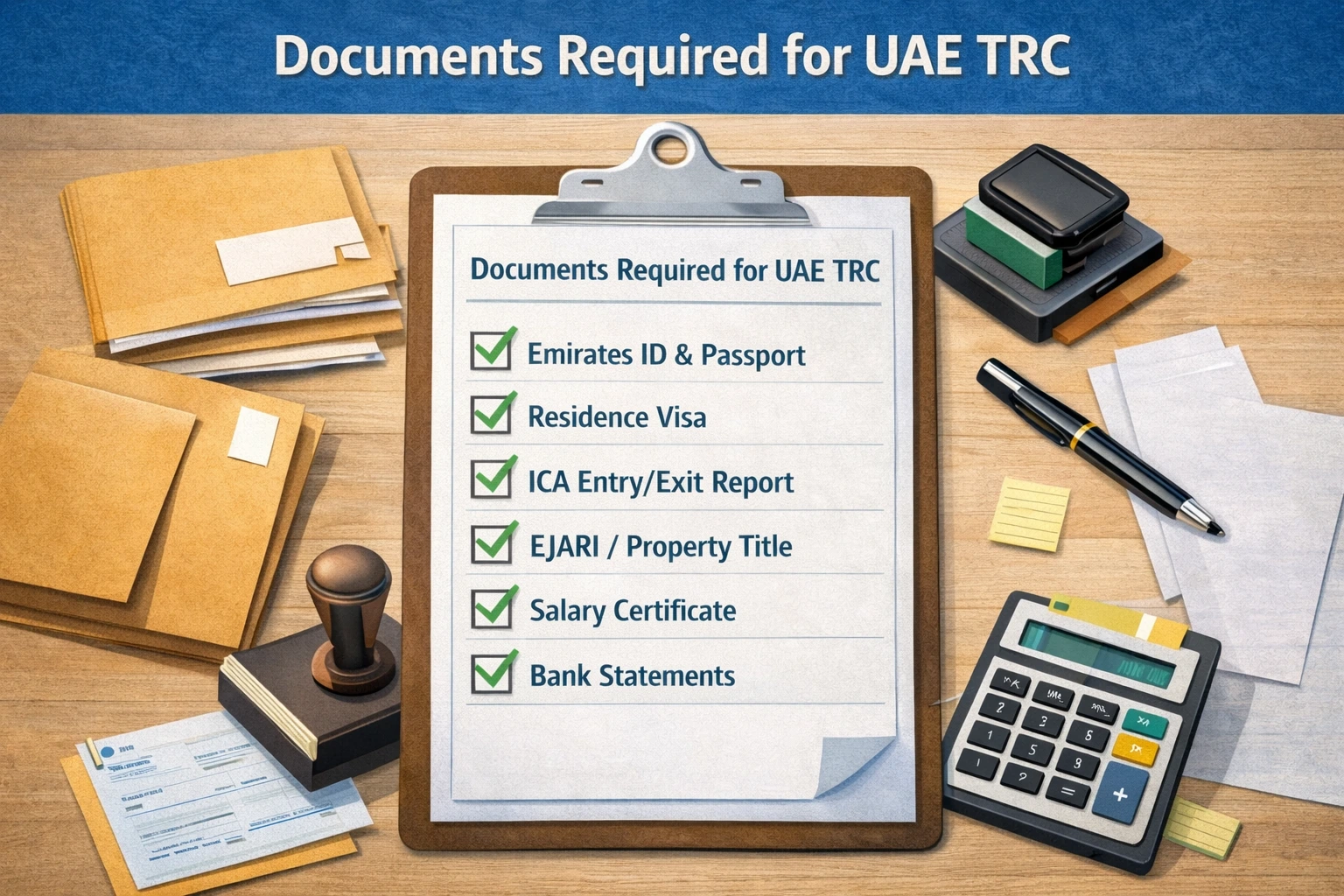
TRC Required Documents for Individuals
Valid Emirates ID and residence visa copy
Passport copy (all pages)
ICA entry/exit report for the relevant period
EJARI tenancy contract or property ownership title deed
Utility bills or other proof of residence
Salary certificate or proof of income source
Bank statements covering the same period
TRC Required Documents for Companies
Trade License copy
Memorandum of Association (MOA)
Valid UAE Corporate Tax TRN certificate
Audited financial statements
Lease agreement or Ejari for the business premises
Bank statements (6–12 months)
Board Resolution authorizing the application
TRC for Companies Without TRN
Companies without a Corporate Tax TRN (such as free zone entities not yet registered for corporate tax) must attach:
Certificate of incorporation
Evidence of effective management and control (EMC) in the UAE
Business activity proof (contracts, invoices, etc.)
Evidence Checklist: Rejection-Proof TRC Pack
| Category | Required Evidence | Purpose |
|---|---|---|
| Residence Proof | EJARI / Ownership Title / Utility Bills | Demonstrates physical presence |
| Income Proof | Salary Certificate / Bank Statements | Confirms source of income |
| Mobility Record | ICA Entry/Exit Report | Verifies 90-day or 183-day test |
| Identity Proof | Emirates ID / Passport | Confirms legal residency |
| Economic Substance | TRN / Company Accounts / Contracts | Confirms business presence |
Fees, Timelines, and Payment Procedures for TRC
UAE TRC Submission and Processing Fees Explained
Application submission fee: AED 50
Processing fee:
AED 500 for individuals
AED 1000 for companies
AED 1750 for DTA-related purposes
Hard copy fee: AED 250 (optional)
Fees subject to change per FTA updates
TRC Approval Timeline and Payment Window
After paying the submission fee, applicants must pay the processing fee within 30 business days once the application is approved for review.
The FTA aims to issue the TRC within 10 business days from final payment, provided all documents meet the required standards.
International Form Stamping (Optional)
For use abroad, TRCs can be stamped and attested by the Ministry of Foreign Affairs (MOFA) in the UAE for an additional fee, depending on the destination country.
Common Reasons UAE TRC Applications Are Rejected (and How to Avoid Them)
1. Missing or Invalid EJARI / Proof of Residence
If your EJARI contract is expired, incomplete, or under another person’s name, your application will likely be rejected. Always upload the latest, valid EJARI showing your name as the tenant.
2. Incomplete ICA Entry/Exit Record
Applicants must provide the ICA report covering the full 12-month period prior to application. Missing travel days or data mismatches cause rejection.
3. Inconsistencies in Income or Salary Certificates
If your salary certificate or bank statement does not align with your declared income, the FTA may deny the application. Ensure all documents reflect consistent and traceable income.
4. Weak or Missing Evidence Pack
Create a “Rejection-Proof TRC Evidence Pack” that includes:
All mandatory documents (PDF format, legible)
Date consistency across all records
Supporting files like tenancy invoices or pay slips
UAE TRC for Free Zone Companies: Special Considerations
Free zone companies are eligible to apply for TRCs, provided they can demonstrate effective management and control (EMC) within the UAE.
Eligibility and Documentation
Active business license from the free zone authority
Board meetings held physically in the UAE
Proof of UAE-based bank account and operational presence
MOA, lease contract, and corporate bank statements
TRC for Companies Without Corporate Tax TRN
Free zone entities not subject to corporate tax can still apply for TRCs to claim DTA benefits. They must prove real substance in the UAE—e.g., physical office, employees, and management presence.
How TRC Supports Double Tax Treaty Benefits (DTA Benefits)

TRC as Proof of Tax Residency for Foreign Authorities
The TRC is a recognized document used internationally to confirm that an individual or company is tax resident in the UAE. This allows foreign authorities to apply reduced withholding taxes under DTAs.
Claiming Treaty Relief Using UAE TRC
A valid TRC enables you to:
Avoid double taxation on income earned abroad.
Benefit from reduced or zero tax rates on dividends, royalties, and interest.
Demonstrate tax compliance and transparency under global standards.
📘 For the list of countries with active Double Tax Treaties with the UAE, visit the Ministry of Finance DTA Portal.
Practical Tips for a Smooth UAE TRC Application in 2026
Ensure your Emirates ID and visa are valid for the entire 12-month period.
Use a consistent address across all documents.
Pay fees promptly within the FTA’s 30-day window.
Prepare all PDFs under 5MB and label them clearly.
Keep bank statements and ICA reports updated before applying.
FAQs about UAE Tax Residency and TRC (2026 Edition)
1. What is the difference between tax residence and tax domicile in the UAE?
Tax residence refers to meeting the physical or legal presence criteria under UAE law, while domicile refers to your permanent home or long-term base.
2. Can I apply for a TRC if I’ve lived in the UAE for less than 183 days?
Yes, under the 90-day test, provided you have a valid residence visa, EJARI, and your financial and personal interests are centered in the UAE.
3. Is the UAE TRC valid for more than one year?
No. Each TRC is valid for one fiscal year and must be renewed annually.
4. What if my TRC application is rejected?
You can reapply after correcting the deficiencies. The FTA usually provides feedback for rejected applications.
5. Can free zone companies apply for TRCs?
Yes. They can, provided they demonstrate effective management and control in the UAE.
6. How do I check the status of my TRC application?
Log in to your EmaraTax dashboard and view your “My Applications” section for live status updates.
Verification & Citations (Official Sources):
• Cabinet Decision No. 85 of 2022 – Determination of Tax Residency (MoF legal repository): Primary landing page: MoF – Financial Legislation.
• Ministerial Decision No. 27 of 2023 – Implementation of Certain Provisions of Cabinet Decision No. 85 of 2022 (PDF): Download.
• Ministerial Decision No. 247 of 2023 – Issuance of Tax Residency Certificate for International Agreements (PDF): MoF PDF | FTA PDF mirror.
• UAE Ministry of Finance – Double Tax Treaty List (country list & details): Visit page. (If the above path changes, use the MoF site search for “double taxation agreements”.)
• OECD Model Tax Convention – Article 4 (Residence): Full version (2017 condensed) | 2017 full volume | 2025 update notes.
• FTA Service Page – Issuance of Tax Certificates for Tax Residency (TRC): Service details
Conclusion: Why Every UAE Resident Should Secure a TRC in 2026
With the introduction of corporate tax and global exchange of information, obtaining a UAE Tax Residency Certificate (TRC) is now essential for tax compliance, treaty benefits, and business credibility.
Whether you’re an expatriate, entrepreneur, or corporate entity, the EmaraTax TRC application process ensures transparency, efficiency, and global recognition of your UAE tax residency status.
PTG Consultant LLC, based in the UAE, provides expert tax residency and EmaraTax support for individuals and businesses in Dubai, Abu Dhabi, and across the Emirates.
Disclaimer:
The information in this article is provided for general educational and informational purposes only and does not constitute legal, tax, or financial advice.
All references, fees, and timelines are based on publicly available publications from the UAE Federal Tax Authority (FTA) and the Ministry of Finance (MoF) as of January 2026. Regulations and official procedures are subject to change. Readers should consult the FTA directly or a licensed tax advisor before making decisions.
For the latest updates, visit the FTA official website
Last Updated: 15/jan/2026
Read our latest E-Invoicing Article See more