
In brief
The UAE Corporate Tax Return includes a specific question on Business Restructuring Relief under Article 27 of the UAE Corporate Tax Law.
The question is not asking whether a company sold an asset, changed shareholders, transferred property or entered into ordinary intercompany transactions. It is asking whether the Taxable Person transferred an entire Business or an independent part of a Business during the Tax Period under a transaction that may qualify for Business Restructuring Relief.
Where no qualifying business restructuring occurred, or where only individual assets were transferred, the appropriate answer will generally be “No”.
Where a qualifying transfer occurred and the Article 27 conditions are satisfied, the answer may be “Yes”, followed by a separate election question in the Corporate Tax Return.
Executive summary
Business Restructuring Relief is a targeted UAE Corporate Tax relief for genuine business reorganisations. It provides no-gain/no-loss treatment where an entire Business or an independent part of a Business is transferred under qualifying conditions.
For Corporate Tax Return Question 5.5.1, the key point is to identify whether the Taxable Person acted as the Transferor and transferred a qualifying Business or independent part of a Business. The question should not be answered “Yes” merely because an asset sale, ownership change, accounting adjustment or ordinary group transaction occurred.
In detail
What is Business Restructuring Relief?
Business Restructuring Relief is a Corporate Tax relief under Article 27 of the UAE Corporate Tax Law.
Where the relief applies, the transfer of qualifying assets and liabilities is treated on a no-gain/no-loss basis for Corporate Tax purposes. In practical terms, this means the transferred Business or independent part of a Business is generally treated as transferred at net book value rather than market value, subject to the relevant conditions.
The relief is intended to support genuine commercial reorganisations and should not be treated as a general exemption for all transfers.
What does Question 5.5.1 ask?
The Corporate Tax Return asks:
“Did the Taxable Person transfer a Business or an independent part of a Business during the Tax Period under which Business Restructuring Relief may apply?”
This question should be considered from the perspective of the Transferor.
A “Yes” answer is generally relevant only where the Taxable Person transferred:
- its entire Business; or
- an independent part of its Business,
and the transaction may satisfy the conditions for Business Restructuring Relief.
If the Taxable Person only received a Business as the Transferee, the relevant reporting is considered separately in the Business Restructuring Relief schedule.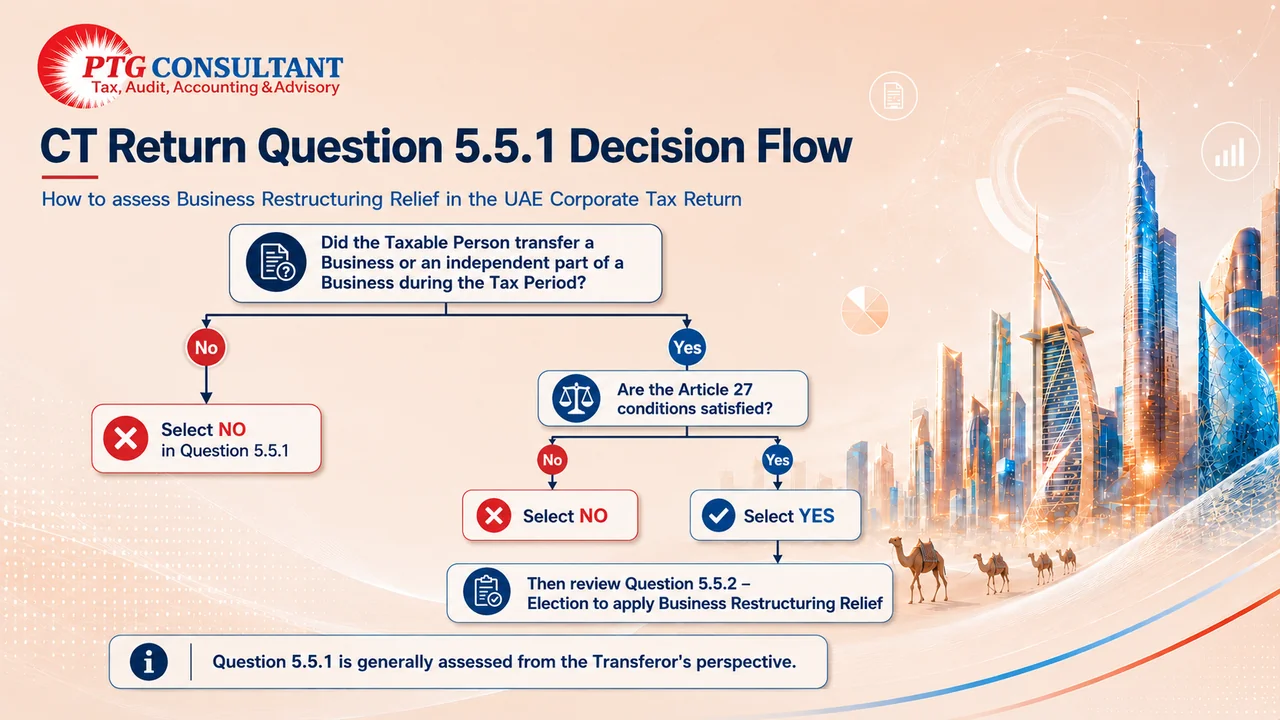
What type of transfer can qualify?
Article 27 broadly covers two types of qualifying restructuring transactions.
1. Transfer of an entire Business or independent part of a Business
A Taxable Person transfers its entire Business or an independent part of its Business to another Person who is, or becomes, a Taxable Person as a result of the transfer.
This is generally in exchange for shares or other ownership interests in the Transferee.
2. Merger or similar restructuring where the Transferor ceases to exist
One or more Taxable Persons transfer their entire Business to another Taxable Person in exchange for shares or ownership interests, and the Transferor or Transferors cease to exist as a consequence of the transaction.
Examples may include qualifying mergers, legal reorganisations, demergers, hive-downs or transfers of a business division, subject to the facts and the applicable conditions.
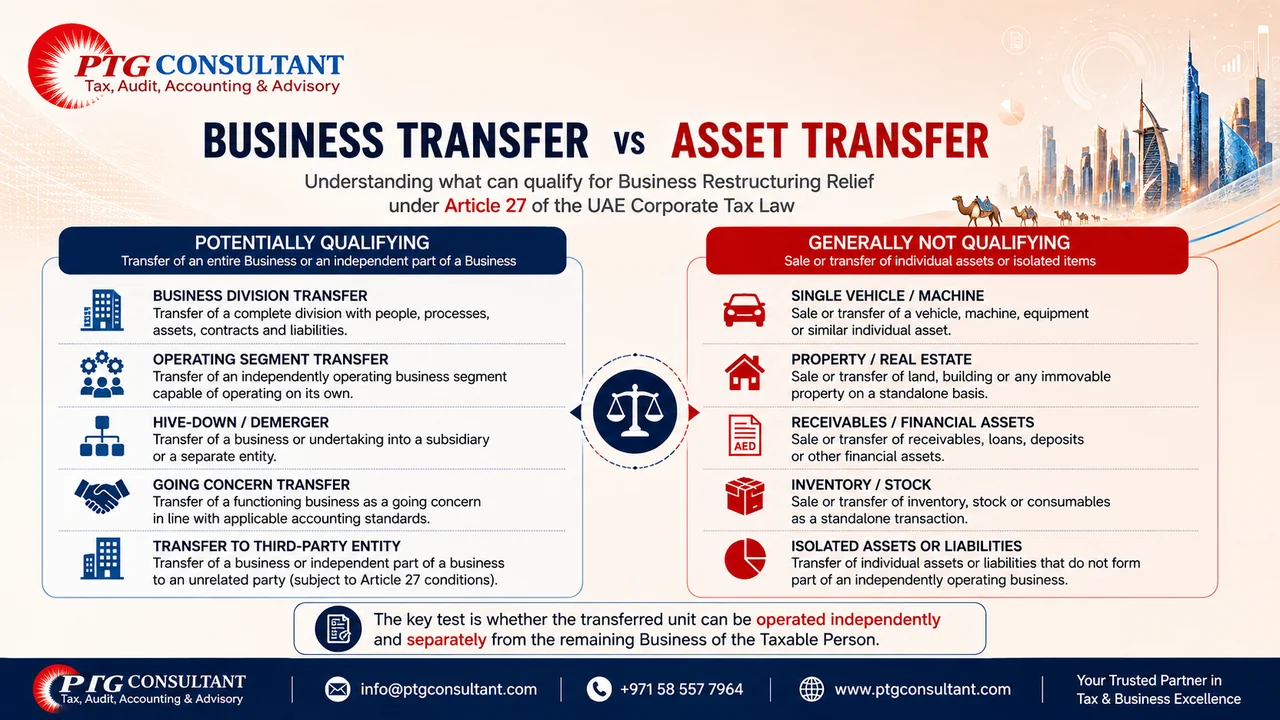
What is an independent part of a Business?
An independent part of a Business should be capable of being operated independently and separately from the remaining Business.
This usually means the transferred assets and liabilities should collectively form a functioning business or operating segment.
Examples that may require review include:
- transfer of a complete division;
- transfer of a business line with people, assets, contracts and liabilities;
- hive-down of an operating business into a subsidiary;
- transfer of a going concern.
By contrast, the sale of an individual asset, machine, vehicle, receivable, property or isolated liability will generally not, by itself, represent the transfer of an independent part of a Business.
Key conditions for Business Restructuring Relief
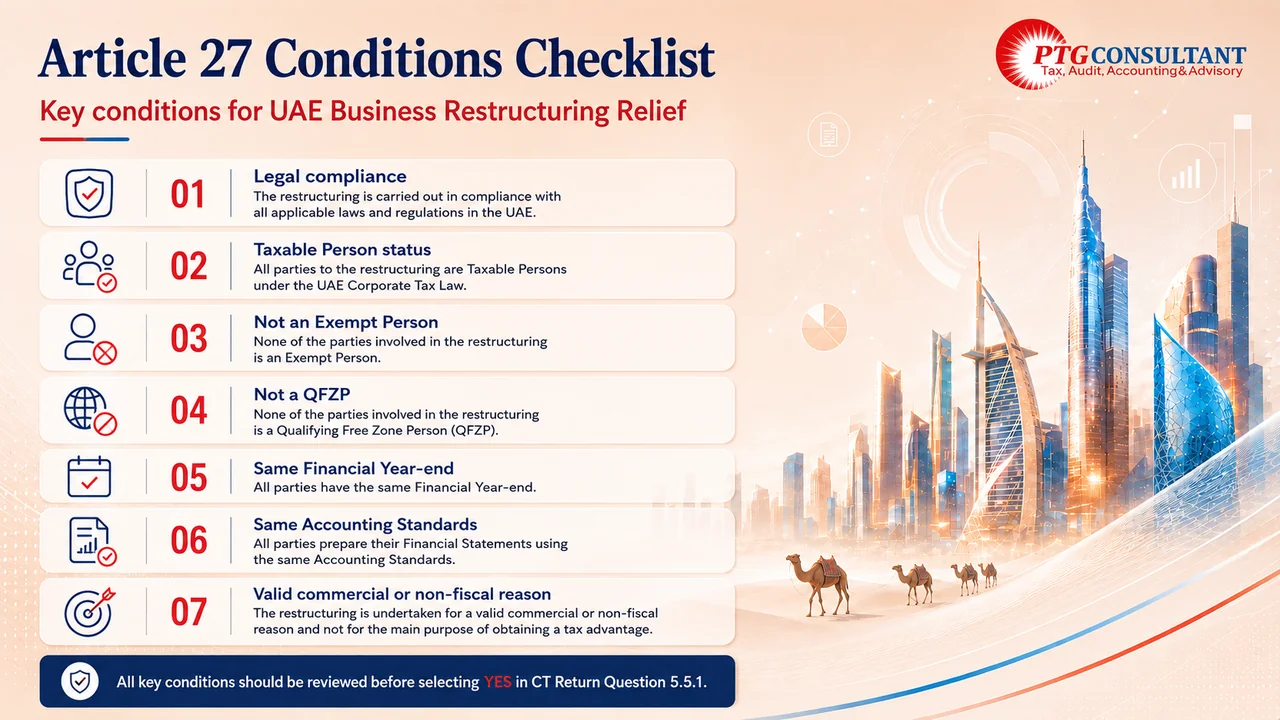
Business Restructuring Relief is not automatic. The Article 27 conditions should be reviewed carefully.
Key conditions include:
- the transfer must comply with applicable UAE legislation;
- the relevant parties must be Resident Persons or Non-Resident Persons with a UAE Permanent Establishment;
- neither party should be an Exempt Person for this purpose;
- neither party should be a Qualifying Free Zone Person;
- the relevant Taxable Persons should have the same Financial Year-end;
- the relevant Taxable Persons should use the same Accounting Standards;
- the restructuring should be undertaken for valid commercial or other non-fiscal reasons that reflect economic reality.
A Resident Person that has elected for Small Business Relief is not entitled to apply Article 27 relief for that Tax Period.
Election requirement
Meeting the conditions does not automatically apply the relief.
The Transferor must separately elect to apply Business Restructuring Relief for the relevant qualifying transaction.
This is why the Corporate Tax Return separates the analysis into two steps:
Question 5.5.1
Did the Taxable Person transfer a Business or independent part of a Business during the Tax Period under which Business Restructuring Relief may apply?
Question 5.5.2
Would the Taxable Person like to make an election to apply Business Restructuring Relief?
Where the election is made, the Taxable Person is directed to complete the relevant Business Restructuring Relief schedule.
Transferor vs Transferee distinction
This is an important point when completing the Corporate Tax Return.
Question 5.5.1 is principally relevant to the Taxable Person acting as the Transferor.
If the Taxable Person did not transfer a Business but only received a Business as the Transferee, Question 5.5.1 may generally be answered “No”, while the separate Transferee question should be reviewed.
The Transferee may need to answer whether it received a Business or independent part of a Business during the Tax Period where the Transferor elected for Business Restructuring Relief.
When should “No” generally be selected?
“No” should generally be selected for Question 5.5.1 where:
- no business restructuring occurred during the Tax Period;
- no entire Business was transferred;
- no independently operating part of a Business was transferred;
- only individual assets or liabilities were sold or transferred;
- the Taxable Person only acted as the Transferee;
- the Article 27 conditions are not satisfied;
- the transaction falls under another provision, such as Transfers Within a Qualifying Group under Article 26;
- there is no election or no qualifying restructuring transaction.
The “No” response should be supported by the facts, documentation and management’s assessment.
Two-year clawback risk
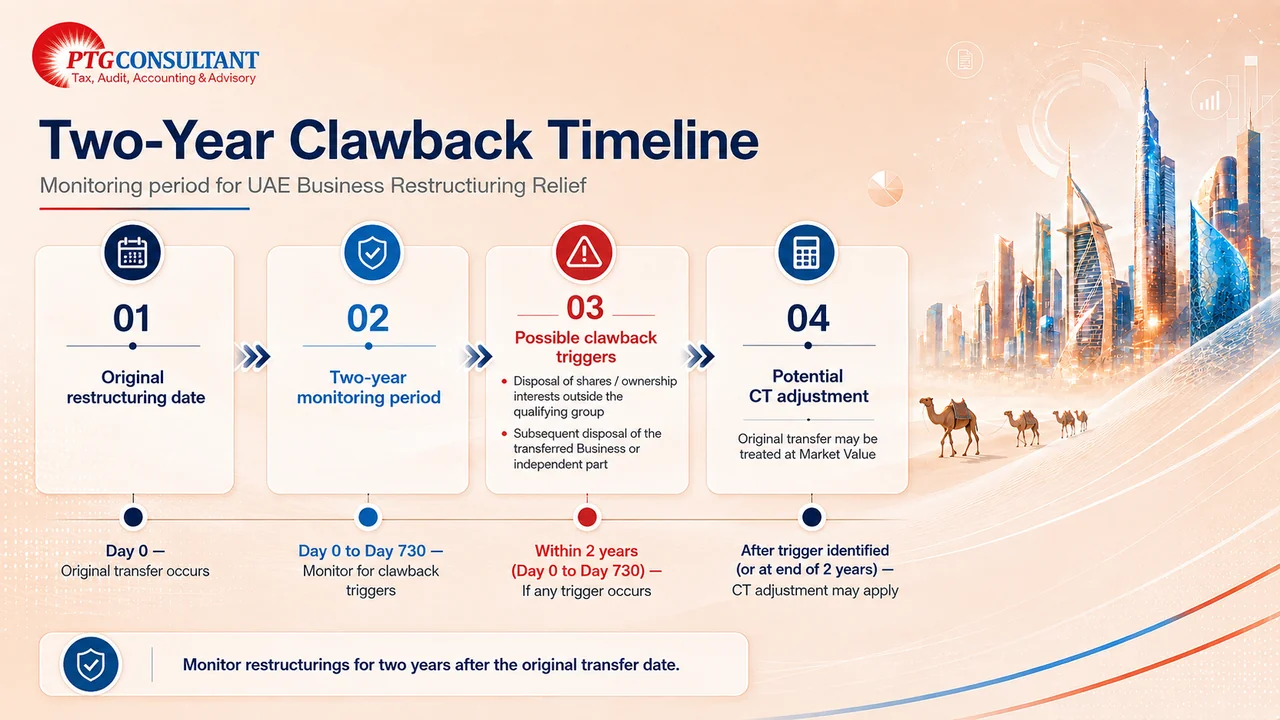
Business Restructuring Relief includes an important two-year clawback rule.
The relief may be clawed back where, within two years of the original restructuring:
- shares or ownership interests in the Transferor or Transferee are sold, transferred or otherwise disposed of to a Person outside the relevant Qualifying Group; or
- the transferred Business or independent part of the Business is subsequently transferred or disposed of.
Where clawback applies, the original transfer may be treated as having taken place at Market Value on the date of the original transfer. This can create a Corporate Tax adjustment in the relevant Tax Period.
Record keeping and evidence
Taxable Persons should maintain appropriate records to support the return position.
The documentation file should generally include:
- restructuring agreement;
- legal documents and approvals;
- board or shareholder resolutions;
- commercial rationale;
- accounting treatment;
- financial statements;
- valuation or net book value workings;
- list of assets and liabilities transferred;
- evidence that the transferred unit can operate independently;
- tax loss attribution workings, where relevant;
- election support;
- clawback monitoring file.
Documentation supporting the commercial rationale and economic reality of the restructuring is particularly important.
Practical CT return decision guide
Use the following approach when completing Question 5.5.1:
Select “No” where:
- no business restructuring occurred;
- only isolated assets were sold;
- the taxpayer only received a Business as Transferee;
- Article 27 conditions are not met;
- the transaction is outside Business Restructuring Relief.
Select “Yes” where:
- the taxpayer transferred an entire Business; or
- the taxpayer transferred an independent operating part of a Business; and
- Article 27 conditions are satisfied; and
- Business Restructuring Relief may apply.
Then separately consider Question 5.5.2 to determine whether the Transferor wishes to elect for Business Restructuring Relief.
Practical impact for UAE businesses
Business Restructuring Relief should be reviewed before completing the Corporate Tax Return where a business transfer, merger, demerger, hive-down, conversion or operating division transfer occurred during the Tax Period.
The analysis should not be limited to accounting entries. Management should review the legal form, commercial purpose, assets and liabilities transferred, going-concern nature, tax status of the parties and whether the Article 27 conditions are met.
A wrong answer may result in incorrect return disclosure, missed relief, incorrect tax computation or future clawback exposure.
Actions to consider
Businesses should consider the following steps:
- Review whether any restructuring, merger, hive-down or business transfer occurred during the Tax Period.
- Identify whether the Taxable Person acted as Transferor or Transferee.
- Distinguish between transfer of a Business and transfer of isolated assets.
- Assess whether the transferred part can operate independently.
- Confirm whether all Article 27 conditions are satisfied.
- Review whether Small Business Relief, Exempt Person or QFZP status affects eligibility.
- Prepare management-approved documentation supporting the commercial rationale.
- Consider whether an election should be made.
- Monitor the two-year clawback period.
- Retain the restructuring file for Corporate Tax audit readiness.
How PTG Consultant L.L.C can support
PTG Consultant L.L.C can support UAE businesses with Business Restructuring Relief assessment, Corporate Tax Return review, Article 27 eligibility analysis, restructuring documentation, transferor/transferee position review, tax loss attribution, clawback monitoring and audit-ready Corporate Tax support.
Before selecting “Yes” or “No” in the Corporate Tax Return, businesses should complete a technical review to ensure the response is aligned with the UAE Corporate Tax Law, FTA guidance and the underlying transaction facts.
Request Corporate Tax Return Review
Conclusion
Business Restructuring Relief under Article 27 is a specific no-gain/no-loss mechanism for genuine business reorganisations. It should not be confused with ordinary asset sales, share transfers, property transfers or Transfers Within a Qualifying Group under Article 26.
For Corporate Tax Return Question 5.5.1, the key test is whether the Taxable Person, acting as Transferor, transferred an entire Business or an independently operating part of a Business during the Tax Period and whether the conditions for Article 27 relief may be satisfied.
Where no qualifying transfer occurred, “No” is generally the appropriate response.
Official source links
Ministry of Finance – Corporate Tax in the UAE
https://mof.gov.ae/en/public-finance/tax/corporate-tax/
Federal Decree-Law No. 47 of 2022 on Corporate Tax and its amendments
MoF announcement on Ministerial Decision No. 133 of 2023
FTA Corporate Tax Guide – Business Restructuring Relief CTGBRR1
FTA Corporate Tax Returns Guide CTGTXR1
https://www.tax.gov.ae/Datafolder/Files/Guides/CT/CT-Returns-EN-11-11-2024.pdf
FTA Corporate Tax Guides and References
https://tax.gov.ae/en/taxes/corporate.tax/corporate.tax.guides.references.aspx
Disclaimer
This article is for general information only and should not be treated as legal or tax advice. The application of Business Restructuring Relief depends on the specific facts, legal documents, accounting treatment, tax status of the parties and applicable UAE Corporate Tax legislation. Professional advice should be obtained before completing the Corporate Tax Return or making an election.