
In brief
The UAE Federal Tax Authority has issued the Top-up Tax Guide | Excluded Entities and Investment Entities | TTGEIE1, providing detailed guidance on which entities may fall outside the charging provisions of the UAE Qualified Domestic Minimum Top-up Tax framework.
The guide is particularly relevant for large multinational enterprise groups, investment structures, funds, pension vehicles, non-profit organisations, real estate investment vehicles and group entities owned by such entities.
A key message from the guide is that Excluded Entity status under the QDMTT rules is not the same as Exempt Person status under the UAE Corporate Tax Law. Even if an entity is exempt for UAE Corporate Tax purposes, it should still independently assess whether it qualifies as an Excluded Entity or Investment Entity for UAE Top-up Tax purposes.
The classification matters because Excluded Entities and Investment Entities located in the UAE are generally not subject to the QDMTT charging provisions. However, their revenue may still be relevant when testing whether the MNE Group meets the EUR 750 million consolidated revenue threshold.
Executive summary
The UAE Top-up Tax regime applies to UAE-located Constituent Entities of in-scope Multinational Enterprise Groups. However, certain entities are carved out from the charging provisions due to their nature, purpose, ownership profile, investment function or public-benefit characteristics.
The FTA’s TTGEIE1 guide explains two important categories:
- Excluded Entities
These include certain Governmental Entities, International Organisations, Non-profit Organisations, Pension Funds, Investment Funds that are Ultimate Parent Entities, and Real Estate Investment Vehicles that are Ultimate Parent Entities. Certain entities owned by primary Excluded Entities may also qualify as secondary Excluded Entities where specific ownership, activities or income tests are met. - Investment Entities
These include Investment Funds, Real Estate Investment Vehicles, Insurance Investment Entities, and certain entities owned by such Investment Entities.
For multinational groups, the practical challenge is not only identifying whether a UAE entity is part of an in-scope group, but also determining whether that entity should be excluded from QDMTT charging, whether its attributes should be removed from calculations, whether an election is available, and whether it has registration or return filing obligations.
This classification should be documented as part of the group’s UAE Pillar Two readiness file.
In detail
Background to the UAE QDMTT framework
The UAE introduced the QDMTT framework as part of its implementation of the global minimum tax rules under Pillar Two.
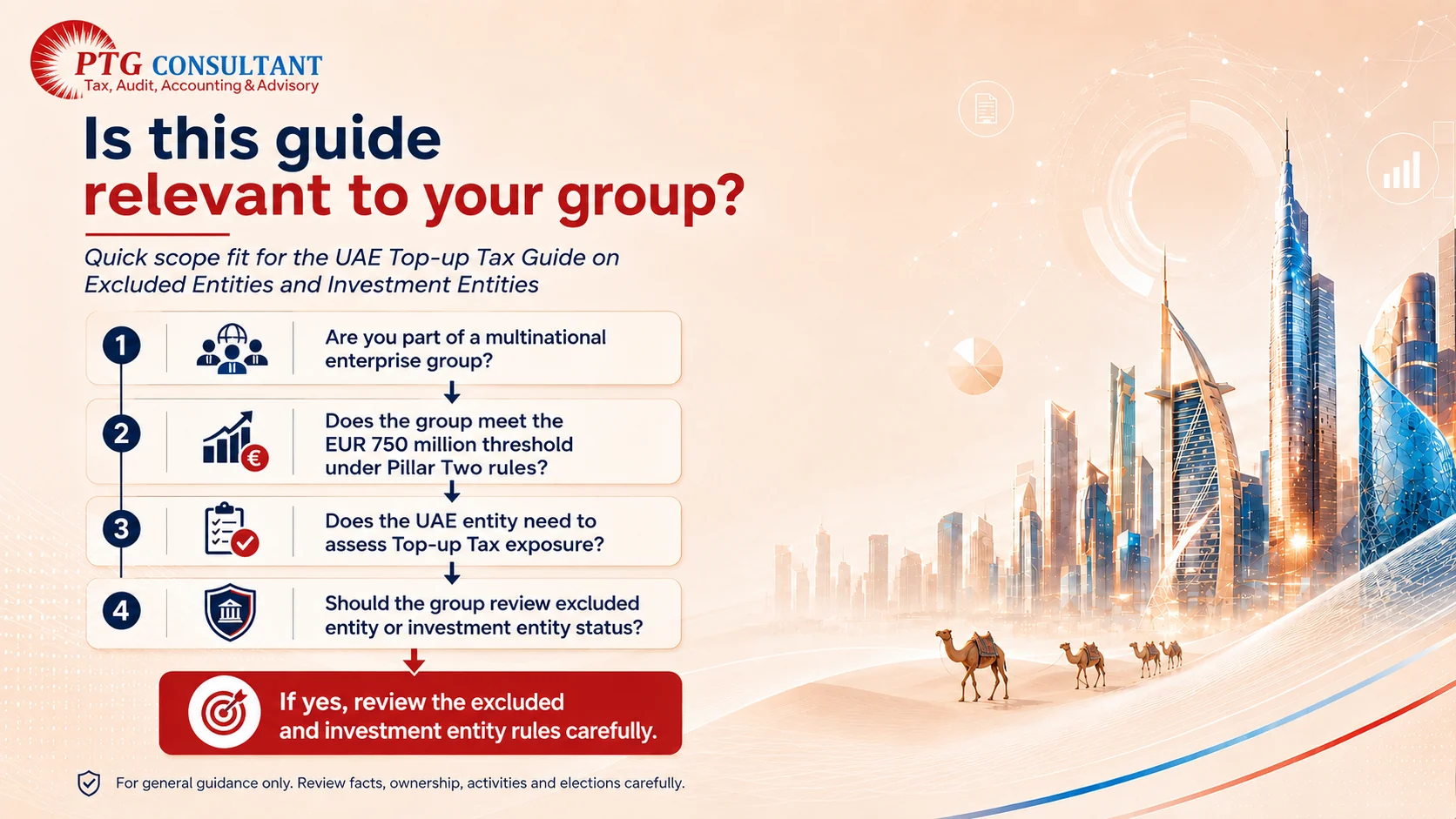
The QDMTT rules apply to Constituent Entities located in the UAE that are members of an MNE Group with annual revenue of EUR 750 million or more in the Consolidated Financial Statements of the Ultimate Parent Entity in at least two of the four Fiscal Years immediately preceding the tested Fiscal Year.
However, not every entity within an in-scope MNE Group is automatically subject to Top-up Tax. Certain entities may fall outside the charging provisions because they qualify as Excluded Entities or Investment Entities.
Why this guide matters
The TTGEIE1 guide is important because it helps multinational groups determine whether a UAE entity:
- is outside the QDMTT charging provisions;
- remains relevant for the EUR 750 million threshold test;
- has no separate Top-up Tax registration or return filing obligation;
- should be included in the group structure information for Pillar Two reporting;
- may be subject to an election that changes its status.
This is a technical classification exercise and should be considered separately from ordinary UAE Corporate Tax exemption analysis.
Excluded Entity is not the same as Exempt Person
One of the most important practical points is that an Excluded Entity under QDMTT is not automatically the same as an Exempt Person under UAE Corporate Tax Law.
The guide states that although there are similarities between the definitions, an Exempt Person under the Corporate Tax Law does not automatically qualify as an Excluded Entity under the QDMTT Legislation. Each entity must independently self-assess whether it meets the QDMTT criteria.
For example, a Qualifying Investment Fund or Qualifying Public Benefit Entity may have a Corporate Tax exemption position, but that does not by itself complete the QDMTT analysis.
Primary Excluded Entities
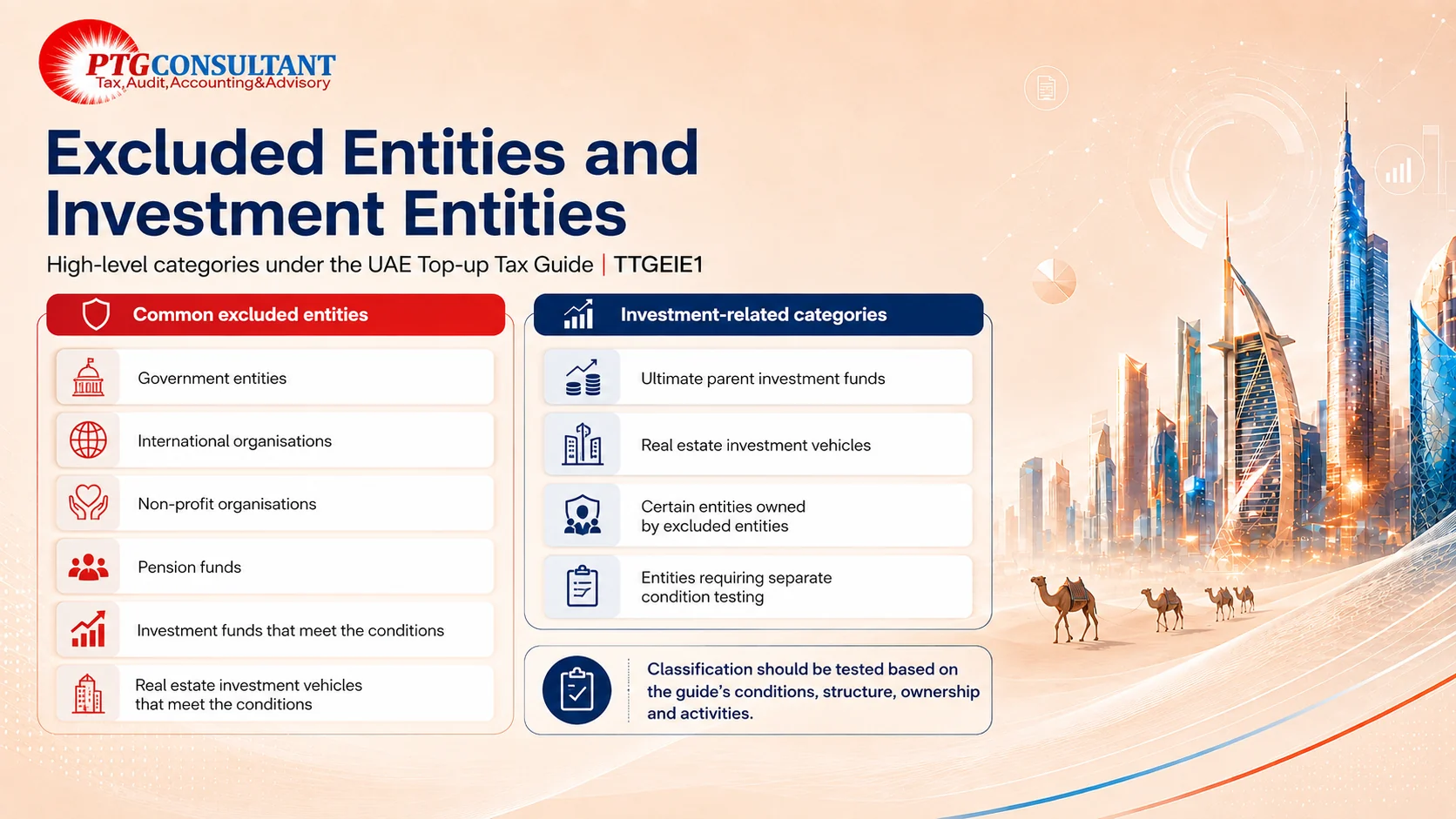
The guide identifies the following categories as primary Excluded Entities:
- Governmental Entity;
- International Organisation;
- Non-profit Organisation;
- Pension Fund;
- Investment Fund that is the Ultimate Parent Entity of an MNE Group;
- Real Estate Investment Vehicle that is the Ultimate Parent Entity of an MNE Group.
The guide provides detailed guidance for each category, except Governmental Entities, which are outside the scope of this particular guide.
International Organisations
An International Organisation may qualify as a primary Excluded Entity where it meets the relevant criteria.
The guide explains that the entity should generally be comprised primarily of governments, have the required legal status or privileges and immunities arrangement, and have governing documents that prevent its income from benefiting private persons.
The focus is on the public or governmental nature of the organisation rather than private commercial benefit.
Non-profit Organisations
A Non-profit Organisation may qualify as a primary Excluded Entity where it meets the required purpose, tax exemption, ownership, distribution and activity restrictions.
In broad terms, the entity should be established and operated for specified public, charitable, religious, scientific, educational, cultural, social welfare or similar purposes. It should not have shareholders or members with a proprietary or beneficial interest in its income or assets. Its income and assets should not be distributed for private benefit except in limited permitted situations, such as reasonable compensation or fair market value transactions.
The guide also highlights that there may be overlap between a Non-profit Organisation under QDMTT and a Qualifying Public Benefit Entity under Corporate Tax, but the two tests are not identical.
Pension Funds and Pension Services Entities
A Pension Fund may qualify as a primary Excluded Entity where it is established and operated exclusively or almost exclusively to administer or provide retirement benefits and related benefits to individuals, and where the required regulatory or benefit-protection conditions are met.
The guide also explains that a Pension Services Entity may form part of the Pension Fund definition. This may include an entity established and operated exclusively or almost exclusively to invest funds for the benefit of a Pension Fund, or to carry out ancillary activities for the Pension Fund, provided the relevant conditions are met.
However, the guide notes an important limitation: while a Pension Services Entity can be a primary Excluded Entity, entities owned by a Pension Services Entity cannot qualify as secondary Excluded Entities.
Investment Fund that is a UPE
An Investment Fund may qualify as a primary Excluded Entity only where it is the Ultimate Parent Entity of the MNE Group.
This means not every investment fund is automatically an Excluded Entity. The fund must meet the investment fund criteria and must be the UPE of the MNE Group.
The guide lists several investment fund criteria, including pooling assets from investors, investing under a defined investment policy, allowing investors to spread risk or reduce costs, generating investment income or gains, giving investors rights to returns, being subject to regulation, and being managed by investment fund management professionals.
The guide also notes that a Qualifying Investment Fund under the UAE Corporate Tax Law may not necessarily be an Excluded Entity under QDMTT, because the conditions are not identical.
Real Estate Investment Vehicle that is a UPE
A Real Estate Investment Vehicle may qualify as a primary Excluded Entity where it is the UPE of the MNE Group.
The guide identifies three broad conditions for a Real Estate Investment Vehicle:
- it should achieve a single level of taxation;
- it should hold predominantly immovable property;
- it should be widely held.
This may be relevant for REITs and real estate holding structures, but the analysis should be performed carefully, particularly where the entity is also treated as exempt under the UAE Corporate Tax rules.
Secondary Excluded Entities
The guide also extends Excluded Entity treatment to certain entities owned by primary Excluded Entities.
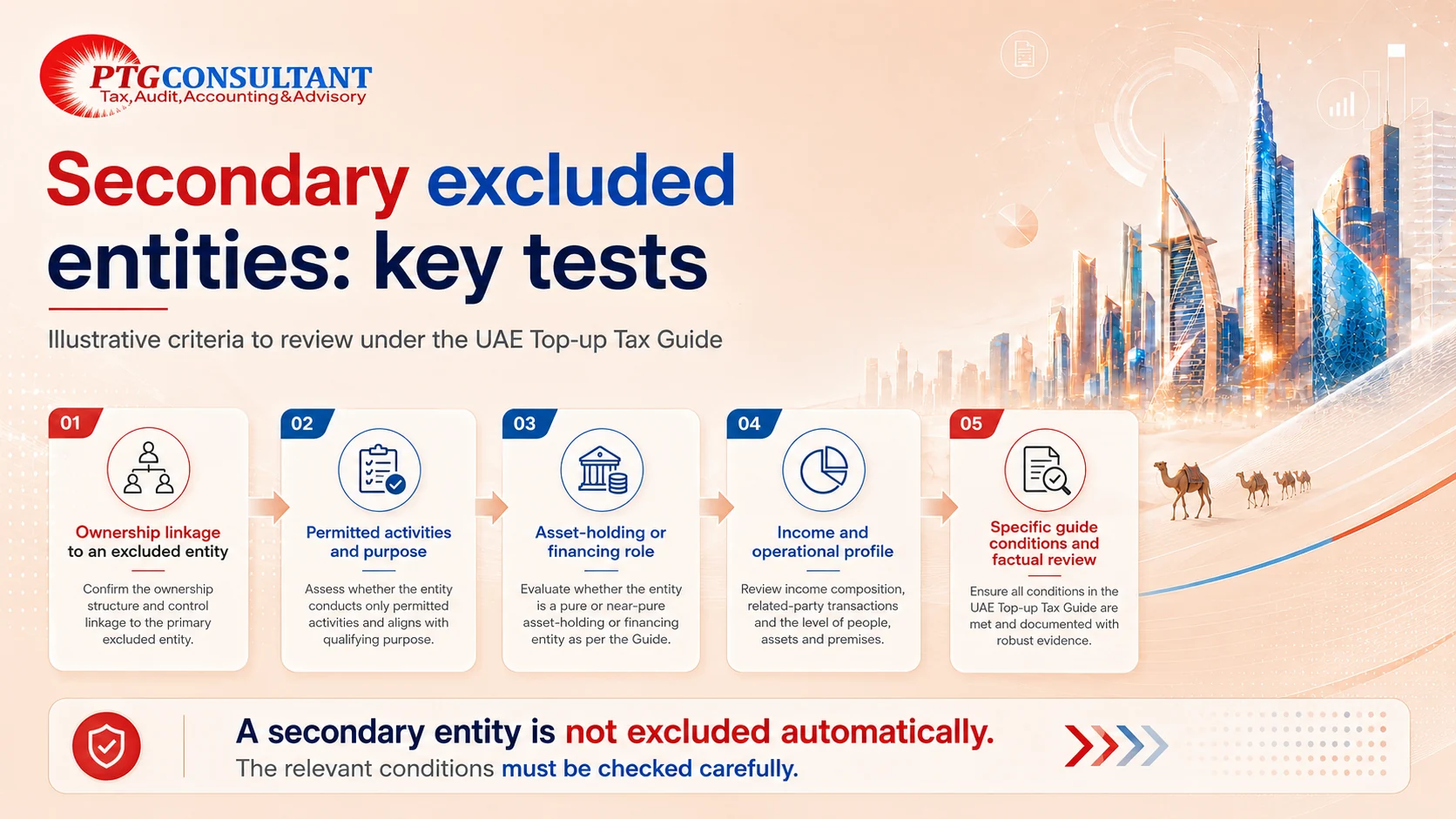
These are referred to as secondary Excluded Entities.
There are two broad types.
First type of secondary Excluded Entity
The first type applies where at least 95% of the value of the tested entity is owned directly or indirectly by one or more primary Excluded Entities, other than a Pension Services Entity, and the tested entity:
- operates exclusively or almost exclusively to hold assets or invest funds for the benefit of the primary Excluded Entity or Entities; and/or
- carries out activities that are ancillary to the activities of the primary Excluded Entity or Entities.
This requires both an ownership test and an activities test.
A key practical point is that the ownership test is based on the value of ownership interests, not merely the number of shares. The guide also explains that beneficial ownership and indirect ownership should be considered carefully.
Second type of secondary Excluded Entity
The second type applies where at least 85% of the value of the entity is owned directly or indirectly by one or more primary Excluded Entities, other than a Pension Services Entity, and substantially all of the entity’s income consists of Excluded Dividends or Excluded Equity Gains or Losses.
This requires both an ownership test and an income test.
This category may be relevant for investment holding companies within fund or exempt structures, particularly where the income is mainly dividends or equity gains.
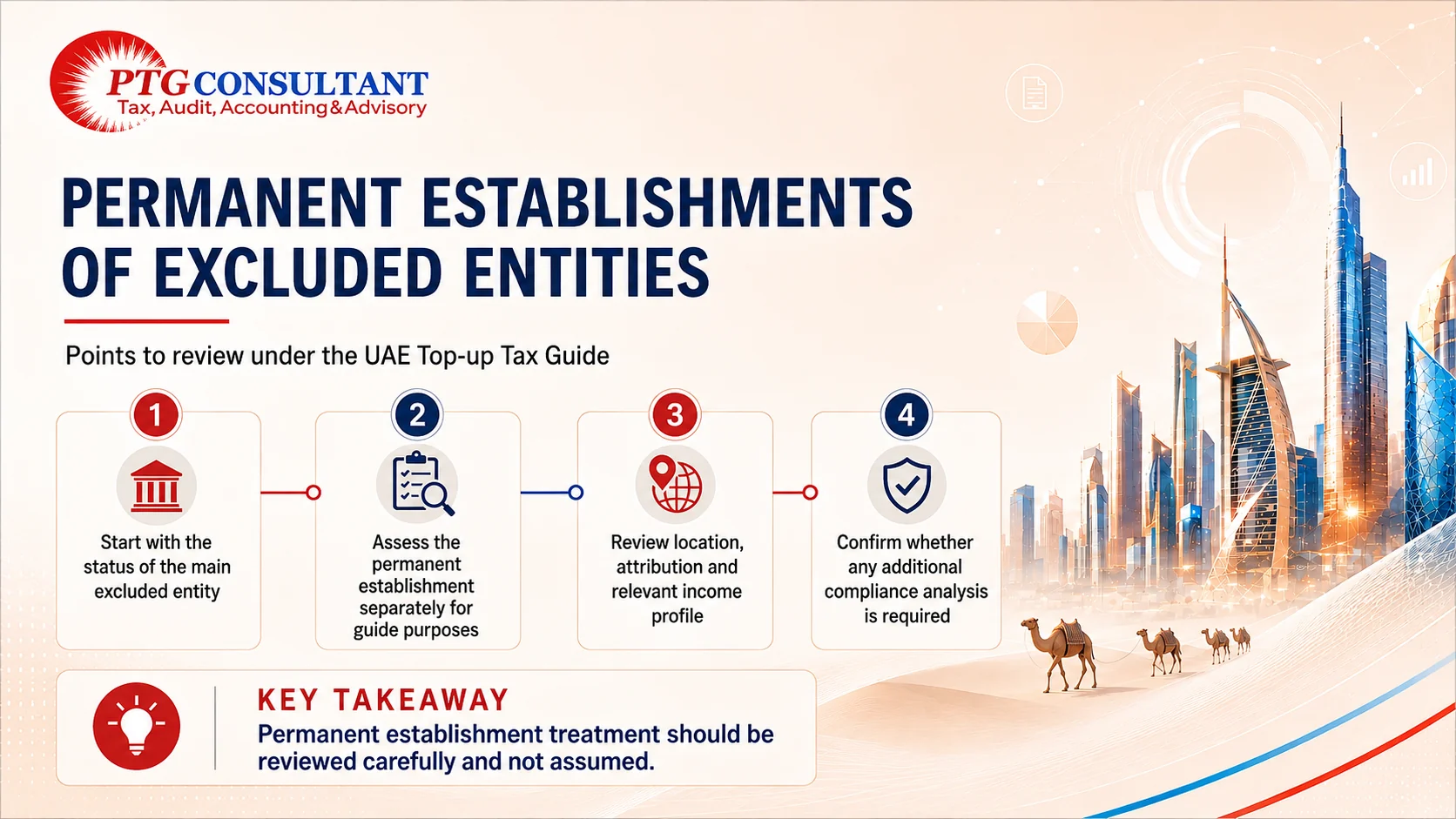
Permanent Establishments of Excluded Entities
Permanent Establishments require separate consideration.
The guide explains that where a Main Entity is a primary Excluded Entity, its Permanent Establishments may also be treated as Excluded Entities.
However, the activities of the Permanent Establishment should be considered when determining whether the Main Entity satisfies the relevant Excluded Entity criteria.
This is important because a UAE branch or permanent establishment conducting third-party commercial activities may affect whether the Main Entity or secondary entity qualifies for exclusion.
Entities held by Non-profit Organisations
The guide also contains a specific rule for certain entities held by Non-profit Organisations.
An entity may be treated as an Excluded Entity where all of the following conditions are met:
- 100% of its value is owned directly or indirectly by one or more Non-profit Organisations;
- the aggregate revenue of the group, ignoring the revenue of Non-profit Organisations and secondary Excluded Entities, is less than EUR 750 million;
- the revenue of the tested entity and other non-excluded entities is less than 25% of the revenue of the MNE Group.
Unlike the secondary Excluded Entity tests, this rule does not include an activities test. However, the revenue conditions are critical and should be carefully modelled using consolidated financial statement data.
Election not to be an Excluded Entity
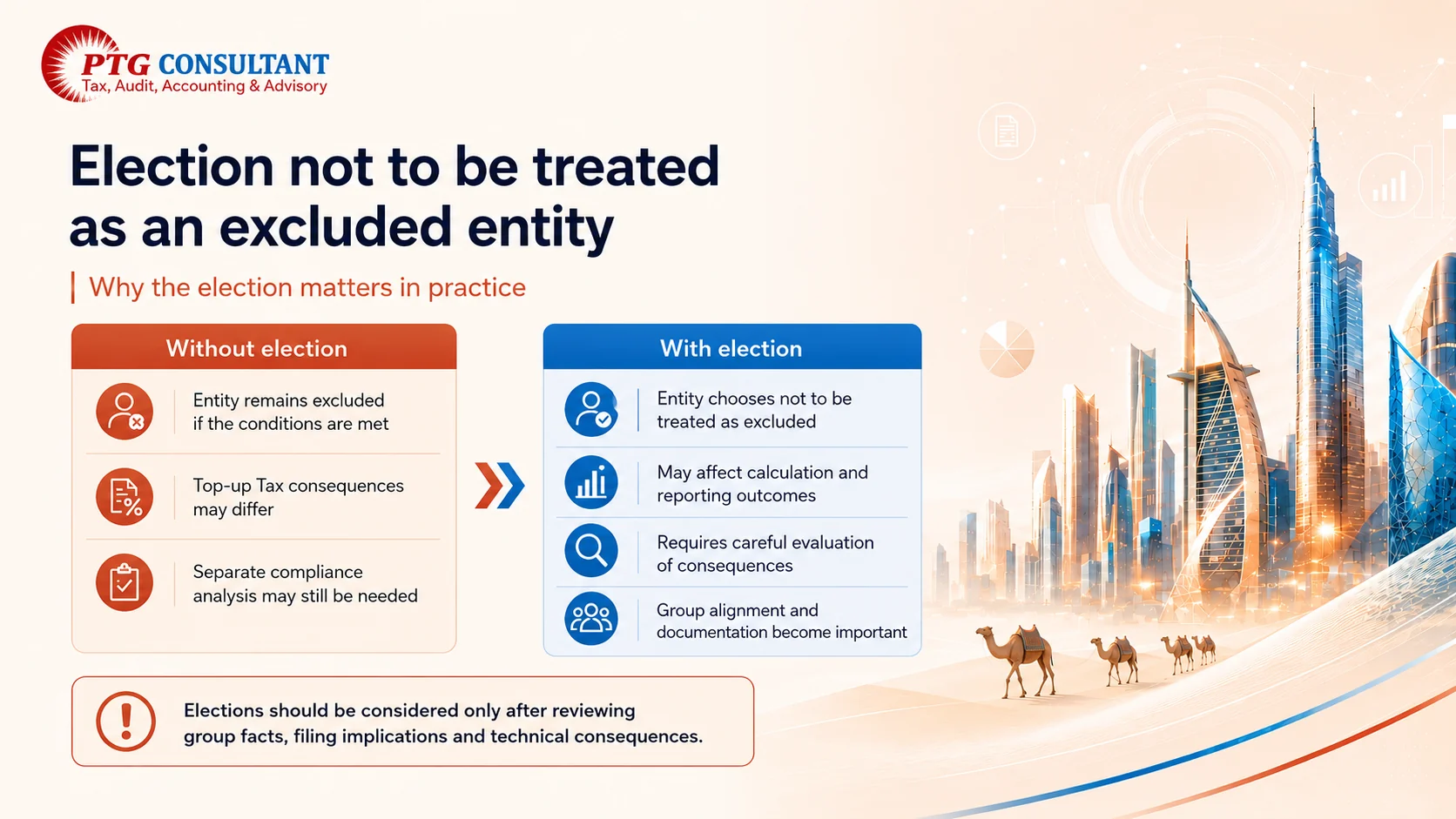
The guide explains that a Filing Constituent Entity may elect not to treat certain entities as Excluded Entities.
This election may apply to:
- an entity that meets the conditions to be a secondary Excluded Entity; or
- an entity wholly owned by one or more Non-profit Organisations that meets the relevant conditions to be treated as an Excluded Entity.
Where the election is made, the entity is treated as a Constituent Entity and becomes subject to the QDMTT framework. It would also be required to register for Top-up Tax purposes.
The guide explains that this is a five-year election and applies on an entity-by-entity basis.
Investment Entities
The guide also explains the meaning of Investment Entities.
An Investment Entity may include:
- an Investment Fund;
- a Real Estate Investment Vehicle;
- an Insurance Investment Entity;
- certain entities at least 95% owned by such Investment Entities and operating to hold assets or invest funds for their benefit;
- certain entities at least 85% owned by such Investment Entities where substantially all income consists of Excluded Dividends or Excluded Equity Gains or Losses.
An Investment Fund or Real Estate Investment Vehicle that is the UPE of an MNE Group may be an Excluded Entity. Where it is not the UPE, it may still be treated as an Investment Entity and may still fall outside the QDMTT charging provisions if located in the UAE.
Insurance Investment Entities
The guide also recognises Insurance Investment Entities.
An Insurance Investment Entity may exist where an entity would meet the definition of an Investment Fund or Real Estate Investment Vehicle except that it is established in relation to insurance or annuity contract liabilities, and is wholly owned by regulated insurance entities within the same MNE Group.
This may be relevant for insurance groups operating in the UAE where investment arms hold or manage assets to support insurance liabilities.
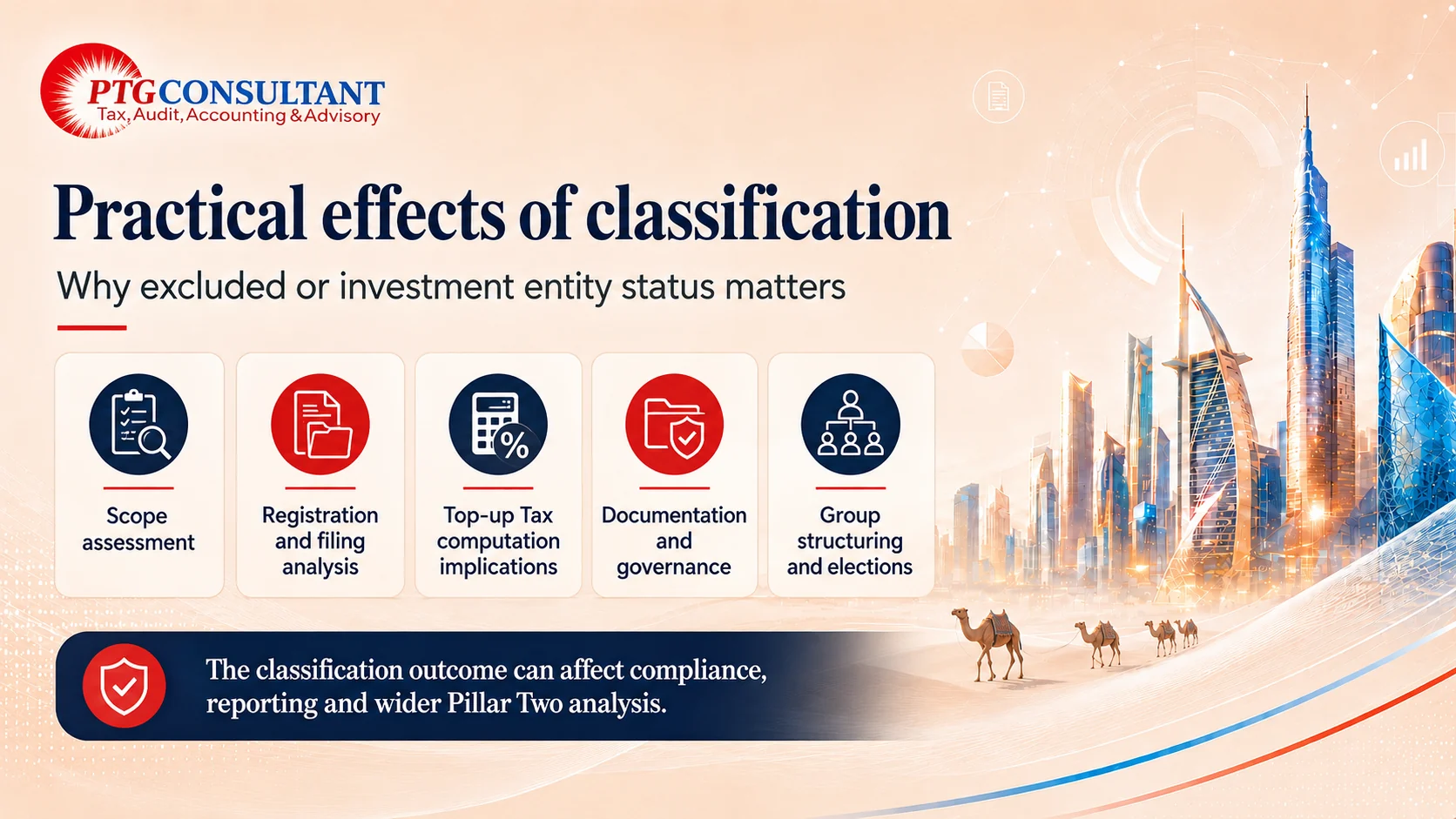
Practical effects of Excluded Entity or Investment Entity status
The guide identifies three major practical effects.
First, an Excluded Entity or Investment Entity located in the UAE is not subject to the QDMTT charging provisions.
Second, in the case of Excluded Entities, their attributes such as profits, losses, taxes accrued, tangible assets and payroll expenses are generally removed from QDMTT computations. Investment Entities may have different treatment where elections are made by Constituent Entity owners.
Third, Excluded Entities and Investment Entities generally do not have separate administrative obligations under the QDMTT framework. For example, they are not required to register for Top-up Tax purposes, file a Top-up Tax Return or file a Pillar Two Information Return.
However, their revenue may still be counted when applying the EUR 750 million consolidated revenue threshold, to the extent that revenue is consolidated in the MNE Group’s consolidated financial statements.
In addition, information about Excluded Entities and Investment Entities should still be included in the overall corporate structure information reported for the MNE Group, although income, taxes, assets and similar details for Excluded Entities should not be reported in the Pillar Two Information Return.
Practical impact for UAE businesses and multinational groups
This guide is particularly important for:
- UAE investment funds and fund managers;
- UAE REITs and real estate investment structures;
- UAE entities owned by pension funds;
- UAE branches of exempt or public-benefit organisations;
- UAE non-profit or public-benefit structures;
- group holding companies owned by excluded or investment vehicles;
- UAE entities within insurance groups;
- multinational groups with UAE investment or holding structures.
The classification should not be assumed based on legal name, licence activity or Corporate Tax exemption status alone.
The analysis should consider the group’s consolidated financial statements, ownership interests, beneficial ownership, income composition, activities, permanent establishment position and Pillar Two classification.
Actions to consider
Affected groups should consider the following steps:
- Identify all UAE entities, branches, funds, trusts, partnerships and investment vehicles in the group structure.
- Determine whether the UAE entity is part of an in-scope MNE Group.
- Assess whether any entity may qualify as a primary Excluded Entity.
- Review whether any group entity may qualify as a secondary Excluded Entity.
- Test the 95% ownership condition and 85% income-based condition where relevant.
- Consider whether any entity is an Investment Entity rather than an Excluded Entity.
- Review the role of Permanent Establishments and whether their activities affect classification.
- Assess whether any election not to treat an entity as an Excluded Entity is commercially or administratively appropriate.
- Document whether the entity has Top-up Tax registration or return filing obligations.
- Maintain supporting evidence for the classification in the group’s Pillar Two readiness file.
How PTG Consultant L.L.C can support
PTG Consultant L.L.C can assist multinational groups and UAE businesses with:
- QDMTT Excluded Entity classification review;
- Investment Entity assessment under UAE Top-up Tax rules;
- comparison of Corporate Tax Exempt Person status versus QDMTT Excluded Entity status;
- primary and secondary Excluded Entity testing;
- 95% and 85% ownership / income test modelling;
- UAE fund, REIT, pension and non-profit structure analysis;
- Permanent Establishment and branch classification review;
- Pillar Two registration impact assessment;
- documentation and governance support for group tax teams.
Before concluding that a UAE entity is outside the Top-up Tax charging provisions, groups should prepare a documented technical assessment aligned with TTGEIE1, TTGREG1 and the wider QDMTT framework.
Request QDMTT Classification Review
Conclusion
The FTA’s TTGEIE1 guide provides important clarity on how Excluded Entities and Investment Entities should be analysed under the UAE Top-up Tax framework.
For affected multinational groups, this is not a simple label-based exercise. The analysis requires a detailed review of purpose, legal form, ownership, beneficial ownership, activities, income profile, regulatory status and consolidated group reporting.
The most important practical message is that UAE Corporate Tax exemption does not automatically determine QDMTT Excluded Entity status. A separate Pillar Two classification review should be performed and documented.
Groups that complete this analysis early will be better positioned to manage registration obligations, Pillar Two reporting, group data collection and QDMTT compliance governance.
Official source basis
This article has been prepared with reference to:
- Federal Tax Authority – Excluded Entities and Investment Entities | Top-up Tax Guide | TTGEIE1 | August 2026
- Federal Decree-Law No. 47 of 2022 on the Taxation of Corporations and Businesses, as amended
- Cabinet Decision No. 142 of 2024 on the Imposition of Top-up Tax on Multinational Enterprises
- Ministerial Decision No. 96 of 2026 on OECD Commentary and Agreed Administrative Guidance
- Cabinet Decision No. 34 of 2025 on Qualifying Investment Funds and Qualifying Limited Partnerships
- Cabinet Decision No. 37 of 2023 regarding Qualifying Public Benefit Entities
Disclaimer
This article is for general information only and should not be treated as legal, regulatory, accounting or tax advice. The application of UAE Top-up Tax depends on the specific facts, group structure, consolidated financial statements, entity classification, ownership arrangements, investment structure and applicable UAE legislation. Professional advice should be obtained before determining whether an entity is an Excluded Entity or Investment Entity under the UAE QDMTT framework.