
Proving that a related-party price is arm's length is the core of UAE transfer pricing compliance. Article 34 of the UAE Corporate Tax Law tells you what the standard is. This guide explains how to meet it: the five transfer pricing methods, the functional analysis that decides between them, and how to pick the right company to test.
1. The five methods, in two families
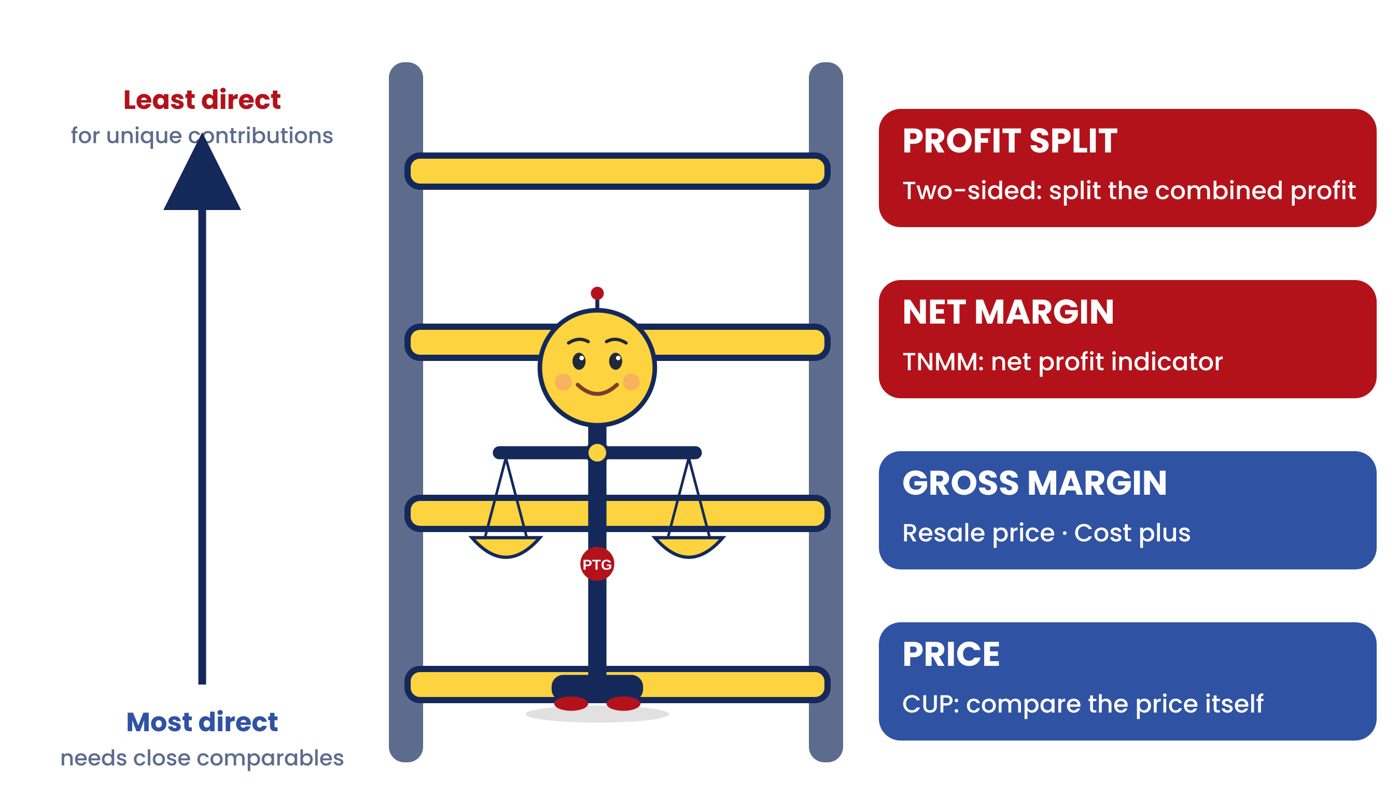
Article 34(3) of Federal Decree-Law No. 47 of 2022 adopts the five internationally accepted methods described in the OECD Transfer Pricing Guidelines:
- Comparable Uncontrolled Price (CUP): compares the price itself.
- Resale Price Method: compares a reseller's gross margin.
- Cost Plus Method: compares a supplier's gross mark-up on costs.
- Transactional Net Margin Method (TNMM): compares a net profit indicator of the tested party.
- Profit Split: splits the combined profit when both parties make unique and valuable contributions.
There is no fixed ranking. The FTA, like the OECD, asks for the most appropriate method for the facts, and your documentation should say why the others were rejected.
2. Worked UAE examples (illustrative)
| Method | UAE example | Result |
|---|---|---|
| CUP | Jebel Ali gold trader: AED 95/kg premium to third parties, adjusted to AED 55/kg; sister company charged AED 20/kg | AED 35/kg under-priced |
| Resale price | Dubai distributor resells for AED 10m; comparable gross margins 22%–28% | Arm's length purchase price AED 7.2m–7.8m (paid AED 8.4m) |
| Cost plus | KIZAD contract manufacturer with AED 30m costs; comparable mark-ups 8%–12% | Price AED 32.4m–33.6m (charged AED 31.2m) |
| TNMM | Abu Dhabi shared services centre with AED 3.5m costs; net cost plus 6.2%–9.8% | Charge AED 3.72m–3.84m, or cost + 5% if low value-adding |
| Profit split | UAE brand owner and Indian developer share AED 20m profit | Routine returns first, then residual split by R&D spend |
3. Which profit indicator for TNMM?
- Operating margin (operating profit ÷ sales): distributors.
- Net cost plus (operating profit ÷ total costs): services and contract manufacturers.
- Return on assets: asset-intensive manufacturing.
- Berry ratio (gross profit ÷ operating expenses): low-risk intermediaries.
4. Functional analysis: the FAR X-ray
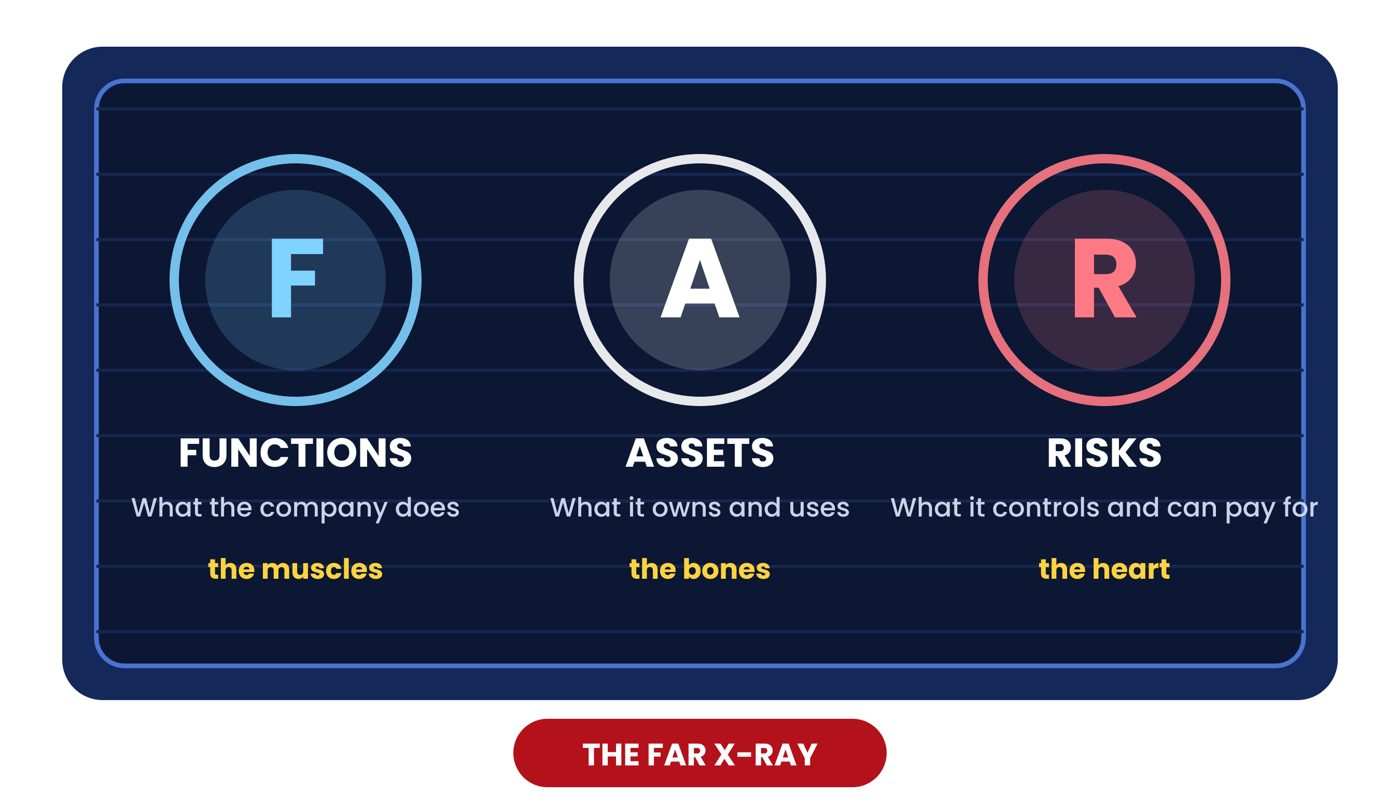
Every method rests on the functional analysis: the functions performed, assets used and risks assumed by each party. Think of it as an X-ray: functions are the muscles, assets the bones and risks the heart. Under the six-step risk framework in the FTA guide, a risk belongs to the party that controls it and has the financial capacity to bear it, whatever the contract says.
5. Characterisation and the tested party
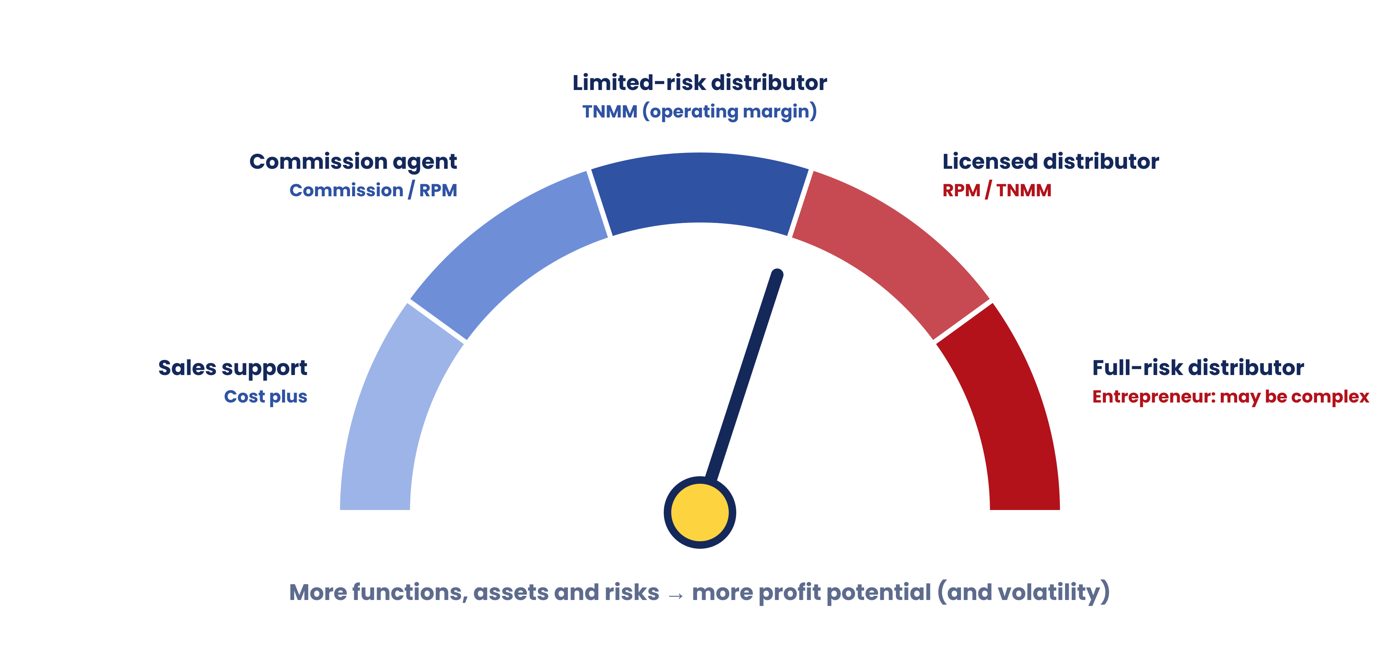
The FAR lets you characterise each company, from a sales support company or commission agent, through a limited-risk distributor, to a full-risk entrepreneur, and from a toll manufacturer to a full-risk manufacturer. For one-sided methods you test the simplest player: the company with the fewest unique functions, assets and risks.
6. What recent cases teach
- Medtronic v Commissioner (US, Eighth Circuit, September 2025): the third-party licence was not a valid comparable, so the method built on it failed. The case is back at the Tax Court.
- Canada v GlaxoSmithKline (Supreme Court of Canada, 2012): judge the supply price together with the licence agreement.
- Commissioner of Taxation v PepsiCo (High Court of Australia, August 2025): a 4–3 majority found no embedded royalty in the concentrate price.
Learn it properly: free PTG course, Module B
Module B of PTG's UAE Transfer Pricing Course has 10 short animated lessons, worked UAE examples, chapter quizzes and a final exam with a PTG certificate and LinkedIn badge.
→ Start Module B free: methods, FAR and characterisation
→ Need help with method selection, a functional analysis or your Local File? Book a consultation
Sources: Federal Decree-Law No. 47 of 2022 (Art. 34, 55); Ministerial Decision No. 97 of 2023; FTA Transfer Pricing Guide (CTGTP1) s.5.1–5.3, 7.2, 7.3, 7.5; OECD Transfer Pricing Guidelines 2022, https://doi.org/10.1787/0e655865-en; public court records. UAE examples are illustrative. General information, not tax advice.