
In brief
UAE e-Invoicing is moving businesses from traditional invoice issuance to structured electronic invoice data exchanged through Accredited Service Providers and reported to the Federal Tax Authority. UAE e-Invoicing roadmap and timelines
For businesses in the UAE, the key question is not only which Accredited Service Provider to appoint. The more important question is whether the ERP system, VAT logic, master data, invoice workflow, PINT-AE mapping and internal controls are ready.
An ASP connection will not fix weak ERP data, incorrect VAT treatment, incomplete customer records, poor credit note controls or missing invoice references. Businesses should therefore complete an ERP readiness review before finalising ASP selection and integration.
Note: Access PTG’s practical slide volumes covering UAE E-Invoicing fundamentals, transaction classification, ERP readiness, ASP integration, PINT-AE mapping, UAT and go-live governance. Download link is available at end of this Article.
What is UAE e-Invoicing?
UAE e-Invoicing is a framework that enables businesses to issue, exchange and report structured electronic invoices through Accredited Service Providers in accordance with Ministry of Finance requirements. A PDF, Word document, scanned invoice, image or email alone is not treated as an eInvoice.
What is an Accredited Service Provider?
An Accredited Service Provider, or ASP, is a service provider approved under the UAE e-Invoicing framework to support the exchange, validation and reporting of electronic invoice data. The ASP acts as the operational gateway between the business, buyer or supplier ecosystem and the tax reporting flow.
What is PINT-AE?
PINT-AE is the UAE-specific electronic invoice data model used to map invoice information into structured, interoperable fields. It covers invoice header data, seller and buyer details, line items, VAT categories, tax amounts, document references and totals.
What is ERP readiness?
ERP readiness means the business system can generate accurate, complete and structured invoice data before submission to an ASP. This includes clean master data, correct VAT codes, controlled invoice types, credit note references, validation rules, API readiness and exception handling.
In detail
UAE e-Invoicing is a data and control project
UAE e-Invoicing should not be treated as an invoice-template change. It is a tax, finance, ERP, data and governance project.
Businesses should move from invoice design to data design. The key focus areas are:
- seller and buyer legal names;
- TRN, TIN and registration details;
- B2B, B2G and B2C customer classification;
- invoice type and credit note type;
- VAT treatment and tax category;
- product or service description;
- unit of measure;
- invoice value, VAT amount and totals;
- PO, contract and delivery references;
- original invoice reference for credit notes;
- ASP submission, acceptance, rejection and resubmission status.
The practical sequence should be:
Transaction facts → VAT treatment → Invoice type → e-Invoicing conclusion → ERP mapping → ASP integration → testing and go-live
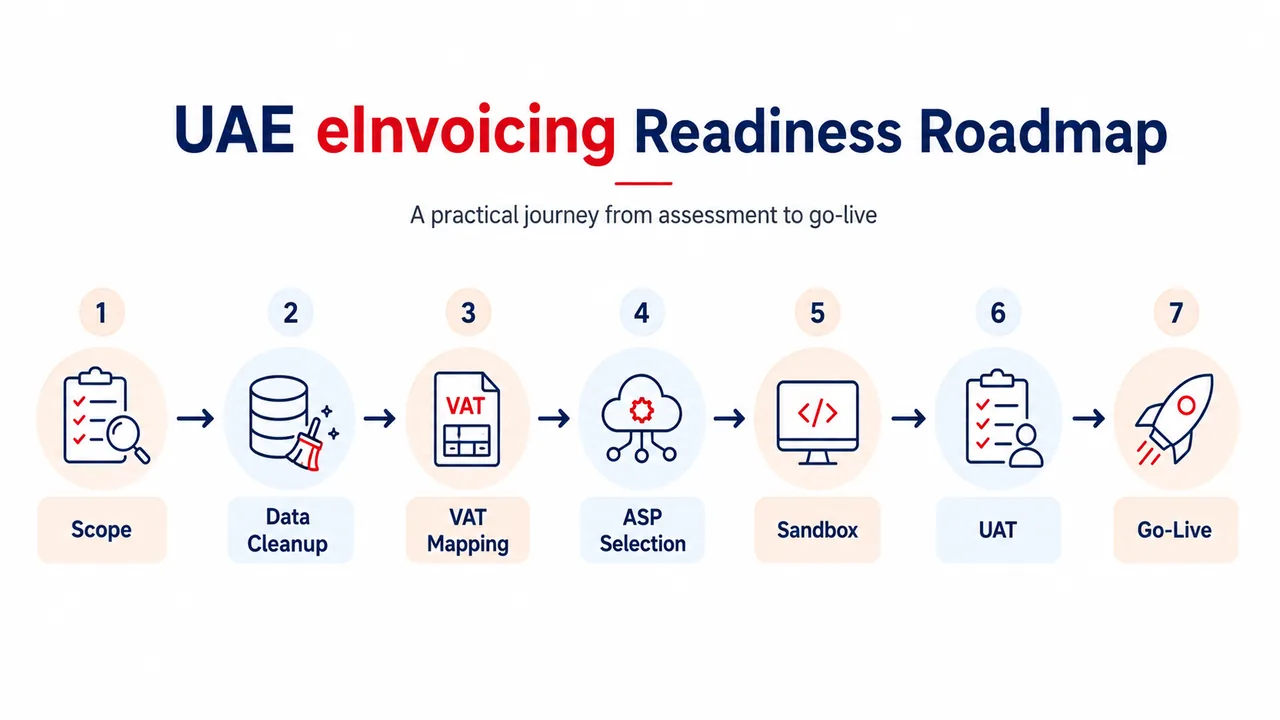
UAE e-Invoicing scope and implementation timeline
Businesses should review the official UAE e-Invoicing scope and timeline based on Ministry of Finance updates.
The UAE e-Invoicing framework applies to relevant business transactions, particularly B2B and B2G transactions, subject to the applicable exclusions and phased implementation timelines.
For businesses with annual revenue exceeding AED 50 million, the Ministry of Finance has announced an extension of the ASP appointment deadline to 30 October 2026, while the mandatory implementation date remains 1 January 2027.
Businesses should monitor official MoF and FTA updates, as technical requirements, implementation phases and onboarding procedures may continue to evolve. UAE e-Invoicing 2026–2027 timeline
Why ASP selection matters
Selecting an ASP is not only a pricing decision. It is a compliance, technology, security and implementation decision.
A business should evaluate whether the ASP can support:
- UAE e-Invoicing requirements;
- Peppol exchange;
- PINT-AE mapping;
- ERP connectivity;
- sandbox testing;
- API documentation;
- invoice validation;
- error handling;
- service-level commitments;
- data security;
- implementation support;
- commercial and liability terms.
The wrong ASP decision can increase implementation cost, delay go-live and create operational risk.
ASP selection decision matrix
Evaluation area | Key question |
|---|---|
| Accreditation | Is the provider listed as pre-approved or accredited under the official UAE process? |
| ERP fit | Does the ASP support your ERP, accounting system or middleware? |
| PINT-AE support | Can the ASP support UAE-specific field mapping and validation? |
| API readiness | Are API documents, sandbox access and testing tools available? |
| Security | How are credentials, invoice data, logs and access rights protected? |
| SLA | What happens during downtime, rejection, delay or failed transmission? |
| Pricing | What are the setup, transaction, support, storage and change request costs? |
| Liability | Who owns failure handling, penalties, rejection delays and support gaps? |
ERP readiness vs ERP not ready
ERP ready | ERP not ready |
| Valid TRNs and legal names | Missing or incorrect TRNs |
| Clean customer and supplier master data | Duplicate or incomplete records |
| Controlled VAT codes | Generic or incorrect tax codes |
| Proper invoice and credit note workflows | Manual corrections without audit trail |
| Original invoice reference captured | Credit notes not linked to original invoices |
| PINT-AE fields mapped | Mandatory fields not available |
| ASP status returned to ERP | Rejections tracked outside the system |
| Dashboard for pending and rejected invoices | No management visibility |
ERP readiness vs ASP selection
ERP readiness | ASP selection |
| Internal business responsibility | External service provider decision |
| Data quality and VAT logic | Connectivity and message exchange |
| Invoice workflow and controls | Transmission and validation support |
| PINT-AE mapping source data | PINT-AE validation and routing |
| Internal exception ownership | SLA and escalation support |
| Audit trail and reporting | Acknowledgement and status response |
PINT-AE and ERP data mapping
PINT-AE mapping should be completed before ASP integration testing.
Key ERP data areas include:
PINT-AE area | ERP source |
| Invoice header | Invoice number, date, type and currency |
| Seller details | Company master data |
| Buyer details | Customer master data |
| Line details | Product, service, quantity, UOM and price |
| VAT details | Tax codes, VAT category, rate and amount |
| References | PO, contract, delivery note and original invoice |
| Totals | Accounting totals and payable amount |
Every required field should have a clear source, validation rule and business owner. UAE tax invoice and VAT compliance
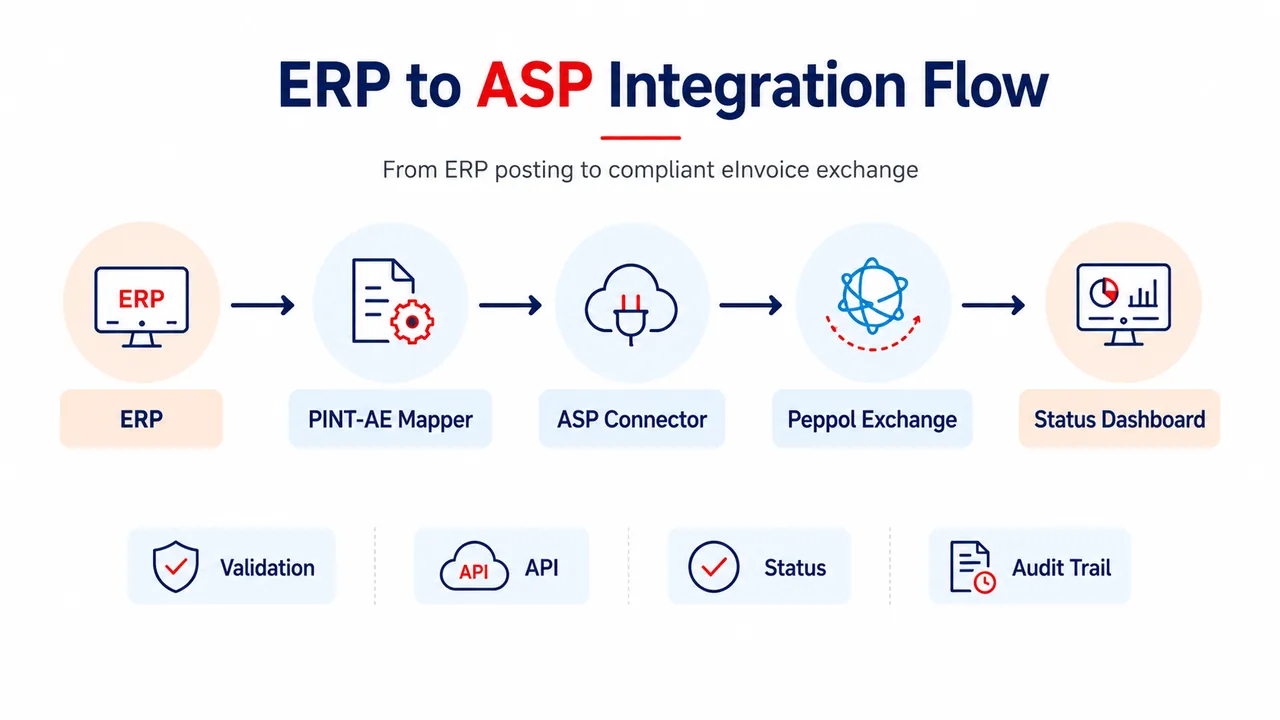
ERP to ASP integration flow
Once PINT-AE mapping is completed, the ERP should generate structured invoice data, submit it through the ASP connector, exchange it through the Peppol network and receive status updates back into the ERP dashboard. The system should capture accepted, rejected, pending and resubmitted invoice statuses for audit trail and operational control.
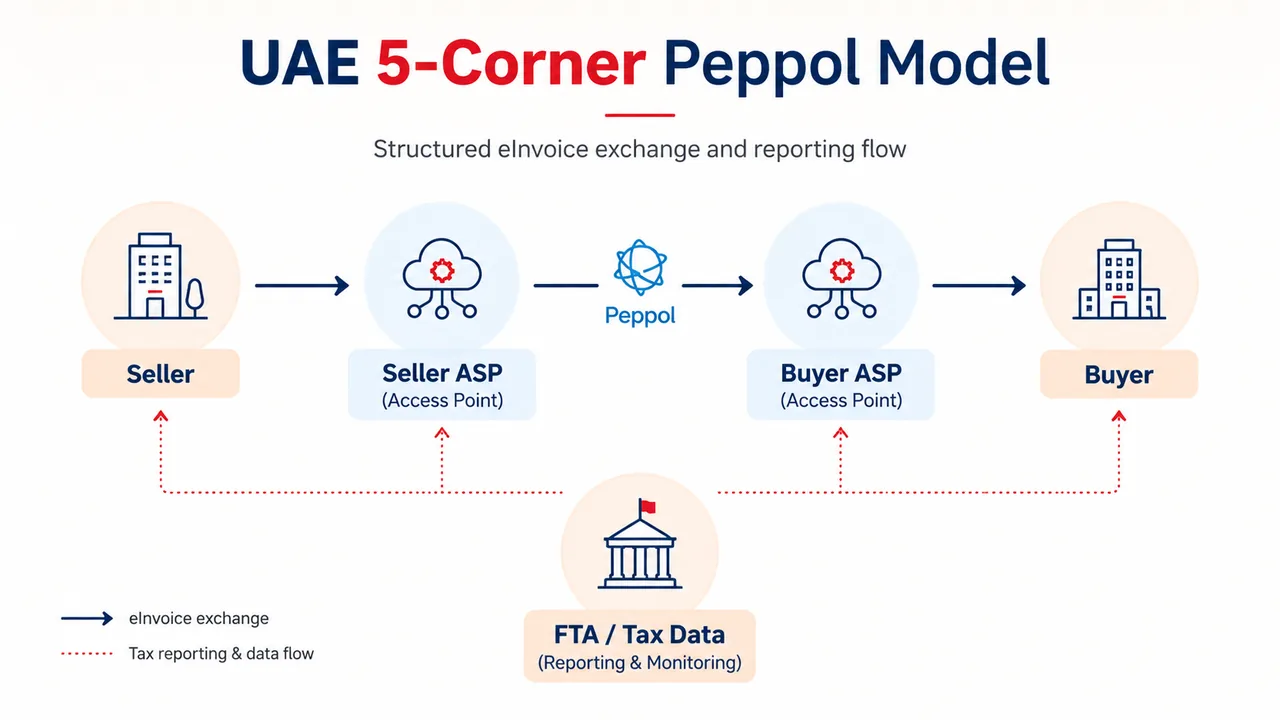
UAE Peppol and 5-corner model
The UAE eInvoicing model uses Peppol-based exchange with Accredited Service Providers and a tax reporting layer.
In practical terms:
- the seller generates structured eInvoice data;
- the seller sends the data to its UAE ASP;
- the seller ASP exchanges the invoice with the buyer ASP;
- the buyer receives the eInvoice through its ASP;
- tax data and message-level statuses are reported and monitored through the UAE reporting layer.
ERP systems should store ASP responses, accepted or rejected status, UUID or reference numbers, error details, resubmission history and audit evidence.
Common ERP integration mistakes
Businesses should avoid the following common mistakes:
- selecting an ASP before completing ERP readiness;
- assuming a PDF invoice is an eInvoice;
- treating every Free Zone or export transaction as automatically out of scope;
- using generic VAT codes without PINT-AE mapping;
- not linking credit notes to original invoices;
- failing to test rejected invoices and resubmissions;
- not defining who owns tax errors and technical errors;
- relying on manual spreadsheets for status tracking;
- ignoring ASP SLA, data hosting and liability clauses;
- testing only simple invoices instead of real business scenarios.
UAE tax invoice and VAT compliance
Industry-specific examples
Construction
Construction businesses should test progress billing, advance payments, retention, variation orders, final accounts and credit note adjustments. Progress certificates are supporting evidence, but invoice and VAT treatment must still be analysed.
Manufacturing
Manufacturers should map raw material imports, finished goods sales, Free Zone or Designated Zone transactions, exports, delivery evidence, product master data and VAT category mapping.
Trading
Trading businesses should test import documents, local B2B sales, Free Zone customers, export evidence, discounts, returns and credit notes.
Professional services
Service businesses should review contracts, service periods, milestone billing, advance payments, cross-border customers and tax point rules. UAE Transfer Pricing practical guide
Retail and e-commerce
Retail and e-commerce businesses should separate B2B, B2C and marketplace workflows, especially where customer type, invoice type and VAT treatment differ.
Readiness checklist before ASP onboarding
Businesses should complete the following before ASP onboarding:
- identify in-scope B2B and B2G transactions;
- review customer and supplier master data;
- validate TRN, TIN, legal name and address fields;
- review VAT codes and invoice types;
- map tax invoice, commercial invoice and credit note workflows;
- define PINT-AE mandatory and conditional fields;
- confirm ERP API or connector capability;
- review ASP sandbox availability;
- prepare positive and negative test cases;
- review ASP pricing, SLA, security and liability terms;
- define error ownership and escalation workflow;
- prepare go-live dashboard and hypercare plan.
The following checklist summarises the key ERP controls businesses should review before ASP onboarding and UAE eInvoicing integration.
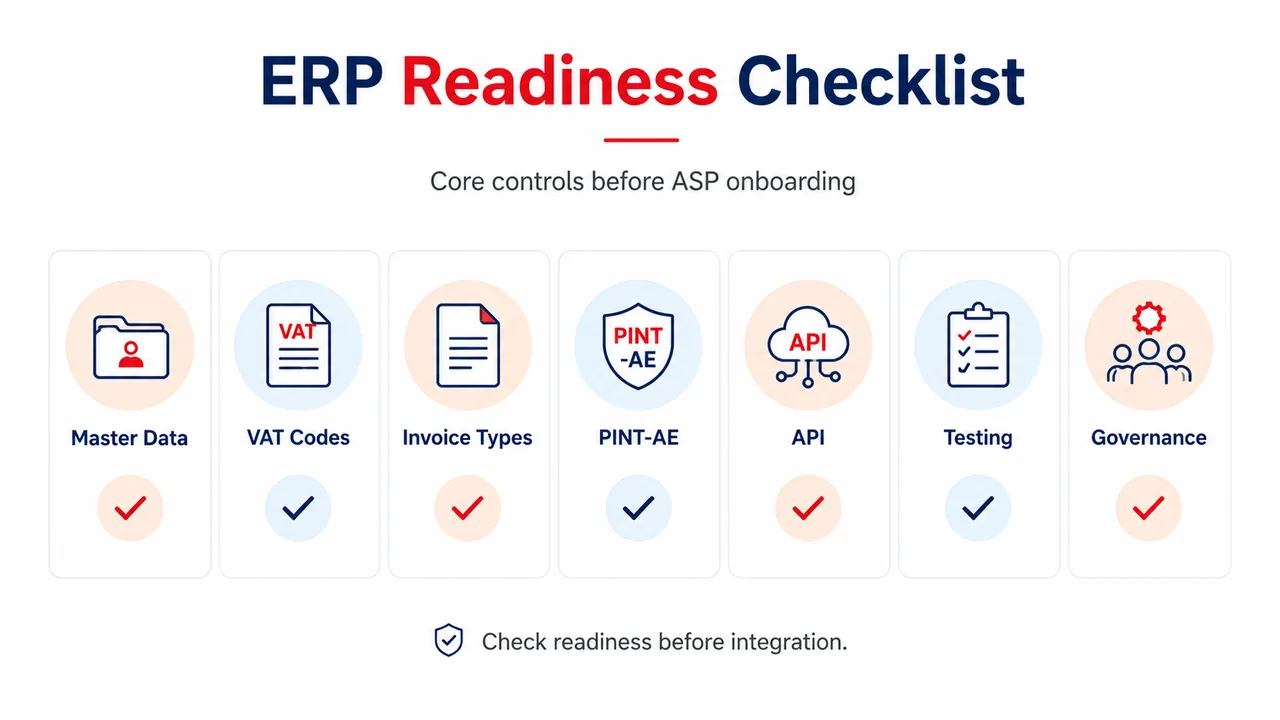
Practical implementation roadmap
Phase | Key activity |
| Phase 1 | Scope and transaction classification |
| Phase 2 | ERP and master data readiness review |
| Phase 3 | VAT code and invoice workflow mapping |
| Phase 4 | ASP shortlisting and commercial review |
| Phase 5 | PINT-AE mapping and connector design |
| Phase 6 | Sandbox testing and UAT |
| Phase 7 | Go-live, monitoring and hypercare |
FAQs
What is UAE eInvoicing?
UAE e-Invoicing is a structured electronic invoicing framework that enables businesses to issue, exchange and report electronic invoice data through Accredited Service Providers in accordance with Ministry of Finance requirements.
Is UAE e-Invoicing mandatory?
UAE e-Invoicing is being implemented in phases. Businesses should review the official Ministry of Finance scope and timeline to determine when they are required to appoint an ASP and implement the system.
What is an Accredited Service Provider?
An Accredited Service Provider is a service provider approved under the UAE e-Invoicing framework to support electronic invoice exchange, validation and reporting between sellers, buyers and the tax reporting layer.
What is PINT-AE?
PINT-AE is the UAE-specific structured data model used for electronic invoice mapping. It defines how invoice information should be converted from ERP data into compliant electronic invoice fields.
Does my ERP need modification for UAE e-Invoicing?
In many cases, yes. ERP systems may need master data clean-up, VAT code mapping, invoice-type controls, credit note references, PINT-AE field mapping, API connectivity and ASP status tracking.
Can Odoo support UAE eInvoicing?
Odoo can be prepared for UAE e-Invoicing through proper configuration, data mapping, validation rules and ASP integration. The exact solution depends on the selected ASP, Odoo version, hosting model and required connector design.
Can Zoho support UAE eInvoicing?
Zoho can be assessed for UAE eInvoicing readiness by reviewing invoice fields, tax codes, customer data, API capability, credit note workflow and ASP integration options.
What happens if an invoice is rejected?
Rejected invoices should be routed to a controlled correction workflow. The business should identify whether the error relates to master data, VAT mapping, PINT-AE structure, ASP validation, API connectivity or business-rule failure.
Should businesses select an ASP before ERP readiness?
Businesses should avoid selecting an ASP based only on price. ERP readiness, data quality, VAT logic, integration capability, testing support, SLA, security and liability terms should be reviewed before final selection.
What is the main risk of poor e-Invoicing implementation?
The main risk is that invoices may be rejected, delayed, incorrectly reported or difficult to reconcile. Poor implementation can affect tax compliance, customer relationships, cash flow and audit readiness.
How PTG Consultant L.L.C can support
PTG Consultant L.L.C can support UAE businesses with e-Invoicing readiness assessment, transaction classification, VAT treatment review, ASP selection support, ERP data mapping, Odoo and Zoho integration readiness, PINT-AE field mapping, sandbox testing coordination, UAT test packs, go-live planning and post-implementation hypercare.
Before selecting an ASP, businesses should complete a tax and ERP readiness review to ensure the selected solution is technically workable, commercially suitable and aligned with UAE e-Invoicing requirements.
Request UAE eInvoicing Readiness Review ->
Conclusion
Successful UAE e-Invoicing implementation depends on three things: clean ERP data, accurate VAT logic and the right ASP selection process.
Businesses that prepare early will be better positioned to avoid invoice rejection, reduce implementation delays, manage compliance risk and achieve a smoother transition to structured electronic invoicing.
The ASP should be selected after readiness has been assessed, not before.
Official references
- Ministry of Finance UAE e-Invoicing Portal
- MoF UAE Electronic Invoicing Guidelines
- MoF Pre-Approved e-Invoicing Service Providers
- MoF Accreditation of e-Invoicing Service Providers
- MoF Scope and Timeline Announcement
- MoF Targeted Amendments to eInvoicing System Decisions
- FTA Corporate Tax / VAT official guidance page
Disclaimer
This article is for general information only and should not be treated as legal, tax or technical advice. UAE e-Invoicing requirements, timelines and technical specifications may evolve. Businesses should refer to official MoF and FTA sources and obtain professional advice before making implementation, ASP selection or ERP integration decisions.