
In brief
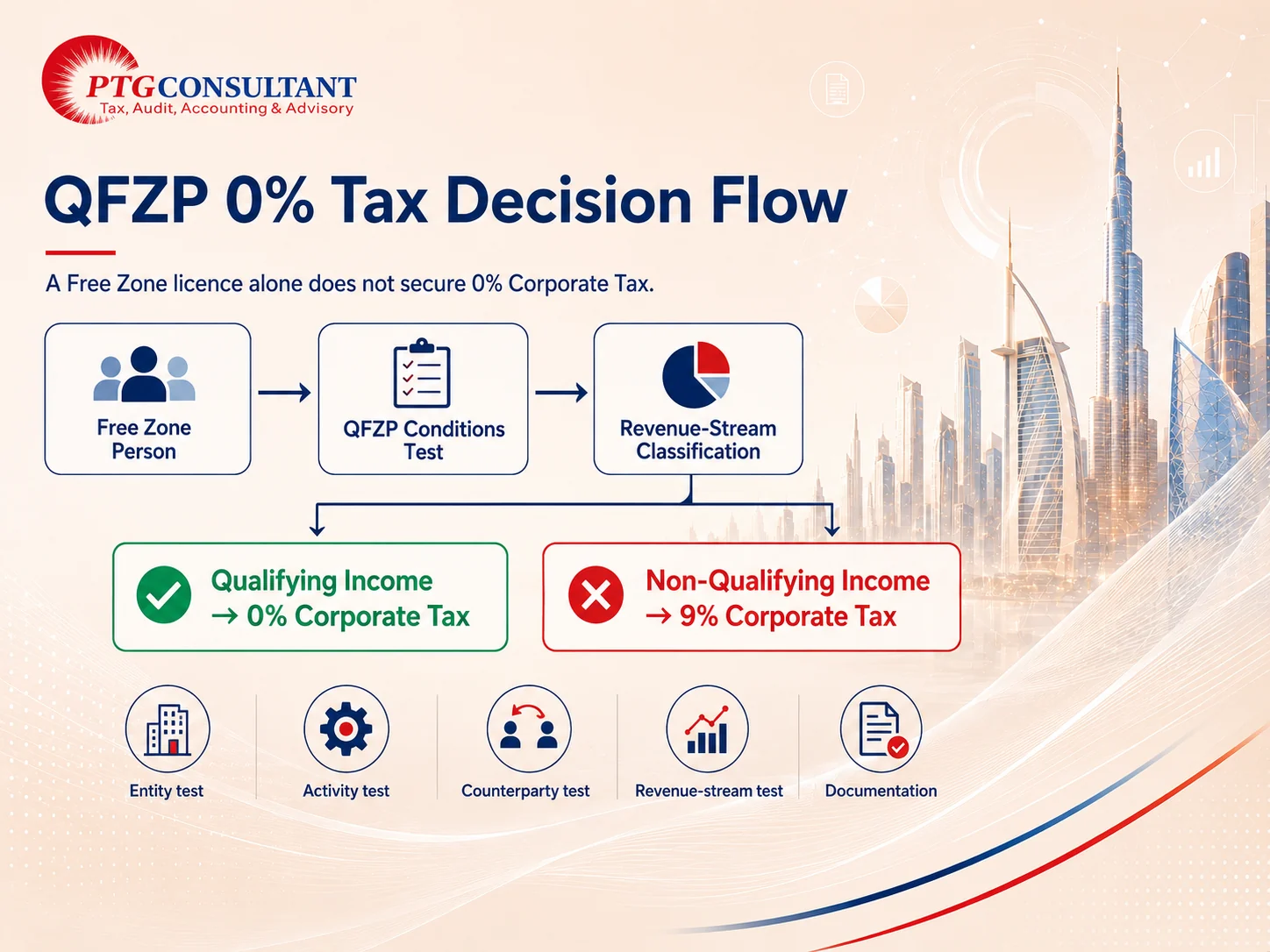
A UAE Free Zone licence does not automatically provide access to the 0% Corporate Tax rate.
The 0% Free Zone Corporate Tax regime applies only where the entity qualifies as a Qualifying Free Zone Person, and only to income that meets the definition of Qualifying Income.
The FTA Free Zone webinar materials cover the key areas relevant to this assessment, including Free Zone concepts, QFZP conditions, Qualifying Income, Qualifying Activities, Excluded Activities, and compliance and reporting obligations.
The practical message for UAE Free Zone businesses is clear:
QFZP status should not be tested only at licence level. It should be tested at entity, activity, counterparty and revenue-stream level.
Key takeaway
Free Zone businesses should move away from the question:
“Are we registered in a Free Zone?”
and instead ask:
“Which revenue streams qualify for 0%, which revenue streams are exposed to 9%, and do we have the documentation to support the position?”
This is the difference between a licence-based assumption and a defensible Corporate Tax position.
In detail
1. Why the Free Zone 0% rate is not automatic
Under the general UAE Corporate Tax framework, taxable income is subject to 0% up to AED 375,000 and 9% above AED 375,000. The Free Zone regime provides a specific relief where qualifying Free Zone businesses can benefit from 0% Corporate Tax on Qualifying Income, while income that is not Qualifying Income is subject to 9%.
This means a Free Zone entity may have:
- income qualifying for 0%;
- income taxable at 9%;
- income requiring de minimis analysis;
- income requiring Beneficial Recipient testing;
- income attributable to a Domestic or Foreign Permanent Establishment.
Accordingly, the Free Zone regime is not a blanket exemption. It is a conditional regime.
2. Legislative updates reflected in the FTA webinar
The FTA webinar slides refer to key legislative updates, including:
- Ministerial Decision No. 229 of 2025 regarding Qualifying Activities and Excluded Activities;
- Ministerial Decision No. 230 of 2025 regarding recognised price reporting agencies;
- Ministerial Decision No. 336 of 2025 regarding the relevant Competent Authority;
- repeal of Ministerial Decision No. 265 of 2023;
- retrospective effective date of 1 June 2023.
The slides also highlight important updates, including removal of the “raw form” requirement for trading Qualifying Commodities, additional commodities and derivatives, expanded treasury and financing scope, and an additional customer category for distribution activities involving public benefit entities.
For taxpayers, this means older Free Zone Corporate Tax analysis should be reviewed and refreshed.
3. What is a Free Zone Person?
A Free Zone Person is a juridical person incorporated, established or otherwise registered in a Free Zone. The FTA slides indicate that this may include UAE or foreign juridical persons with a registered branch in a Free Zone, Free Zone authorities, Government Controlled Entities established in a Free Zone, and an Unincorporated Partnership approved as a Taxable Person.
A key point is that a Free Zone Person refers to the entire juridical person, not only the Free Zone office or branch. The slides distinguish Free Zone operations as the Free Zone parent, while taxable presence outside the Free Zone may be treated as a Domestic Permanent Establishment or Foreign Permanent Establishment.
This distinction is critical where a company has offices, branches, employees, warehouses or business operations outside the Free Zone.
4. Free Zone versus Designated Zone
For Corporate Tax purposes, a Free Zone is a designated and defined geographic area in the UAE.
A Designated Zone has a more specific role. The FTA slides explain that a Designated Zone is treated as a Designated Zone for VAT purposes under Cabinet Decision No. 59 of 2017 and is recognised as a Free Zone for Corporate Tax purposes. The slides also note that Taxable Persons should check with their respective authority to confirm whether they operate in a Free Zone or Designated Zone for Corporate Tax purposes.
This distinction is particularly important for distribution of goods or materials, where Designated Zone conditions may be relevant.
QFZP conditions
5. Conditions to be a Qualifying Free Zone Person
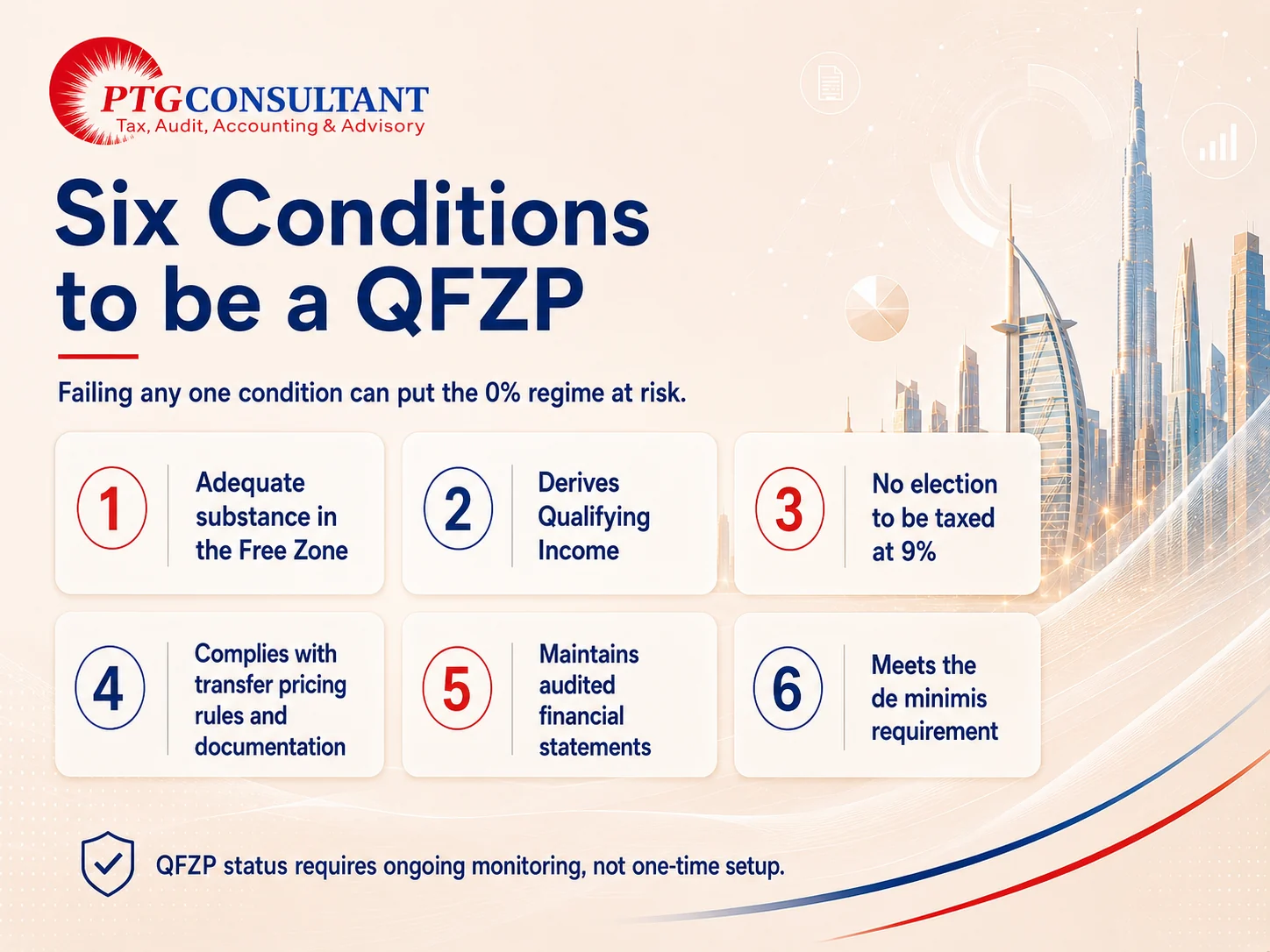
A Free Zone Person is deemed to be a QFZP unless it fails to meet any of the required conditions.
The FTA slides summarise the QFZP conditions as:
- maintain adequate substance;
- derive Qualifying Income;
- not elect to be subject to Corporate Tax at 9%;
- comply with transfer pricing provisions and maintain relevant documentation;
- maintain audited financial statements;
- meet de minimis requirements.
These conditions should be tested annually and documented before filing the Corporate Tax return.
6. Adequate substance
A QFZP must maintain adequate substance in a Free Zone or, for distribution activities, in a Designated Zone.
The FTA slides state that the QFZP should perform core income-generating activities in the relevant Free Zone or Designated Zone and should have adequate assets, full-time employees and operating expenditure in relation to each activity. The number of qualified full-time employees should be adequate based on the nature and size of the activities.
From a practical perspective, substance should support the revenue being treated as Qualifying Income. A licence and office lease alone may not be sufficient.
7. Transfer pricing
Transfer pricing is a central part of QFZP compliance.
The FTA slides state that a QFZP must comply with the arm’s length principle for transactions with Related Parties and arrangements between a Free Zone parent and Domestic or Foreign Permanent Establishments. The slides also refer to master file, local file and disclosure form requirements where relevant thresholds are met.
This is especially important where profits must be allocated between:
- Free Zone parent;
- Domestic Permanent Establishment;
- Foreign Permanent Establishment;
- Related Parties.
The allocation should be consistent with functions performed, assets used and risks assumed.
8. De minimis requirement
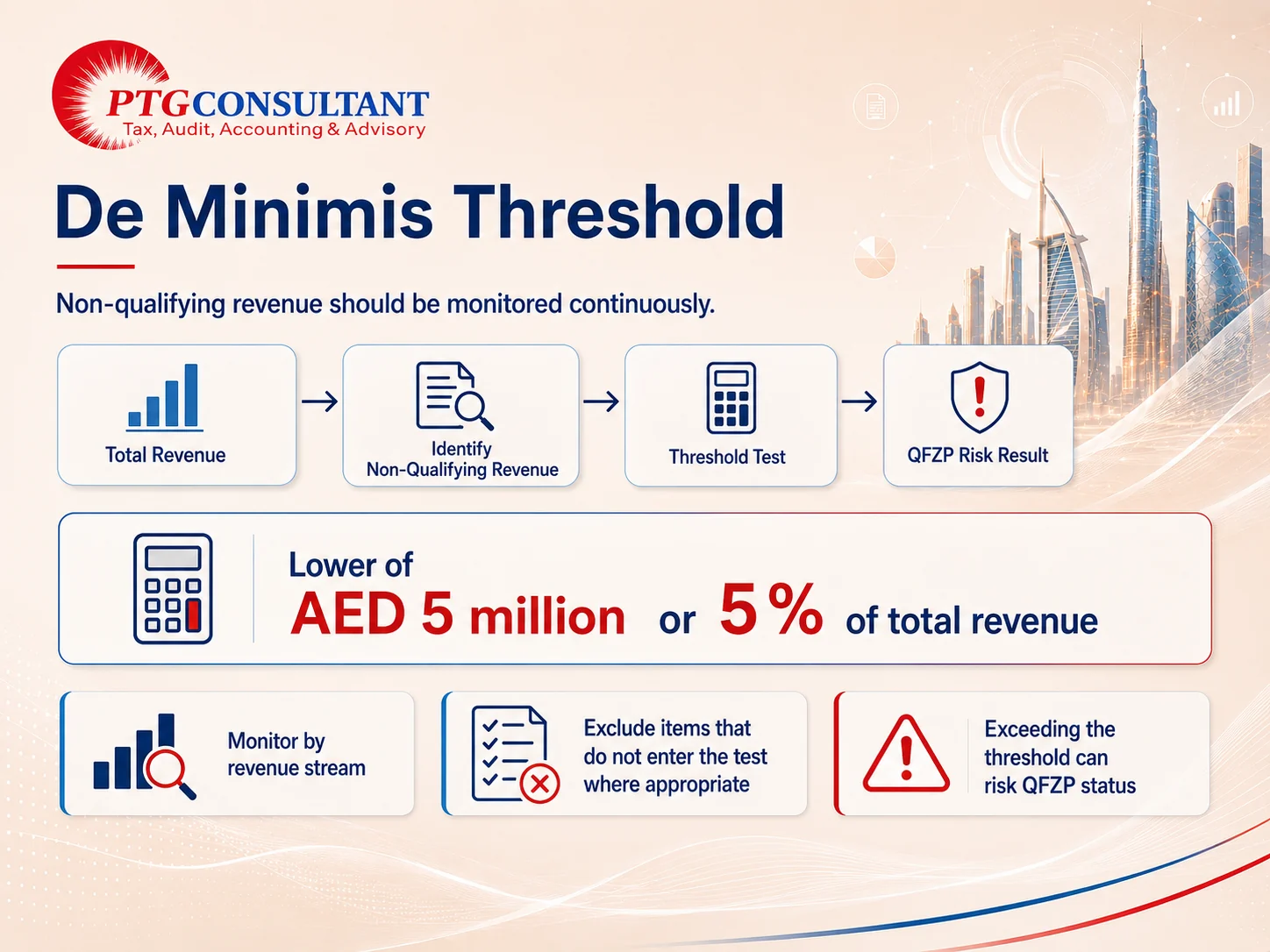
The de minimis rule allows limited non-qualifying revenue without automatically losing QFZP status.
The FTA slides state that the de minimis requirement is met where the QFZP’s non-qualifying revenue does not exceed the lower of:
- AED 5 million; or
- 5% of total revenue.
This should be monitored during the year. It should not be treated as a year-end clean-up exercise.
Qualifying Income analysis
9. The revenue-stream test
The most important practical test is the revenue-stream test.
Each major income stream should be classified separately. This may include:
- sales to Free Zone Persons;
- sales to mainland customers;
- related party service income;
- distribution income;
- logistics income;
- treasury or financing income;
- income from intellectual property;
- income from immovable property;
- income attributable to branches or permanent establishments.
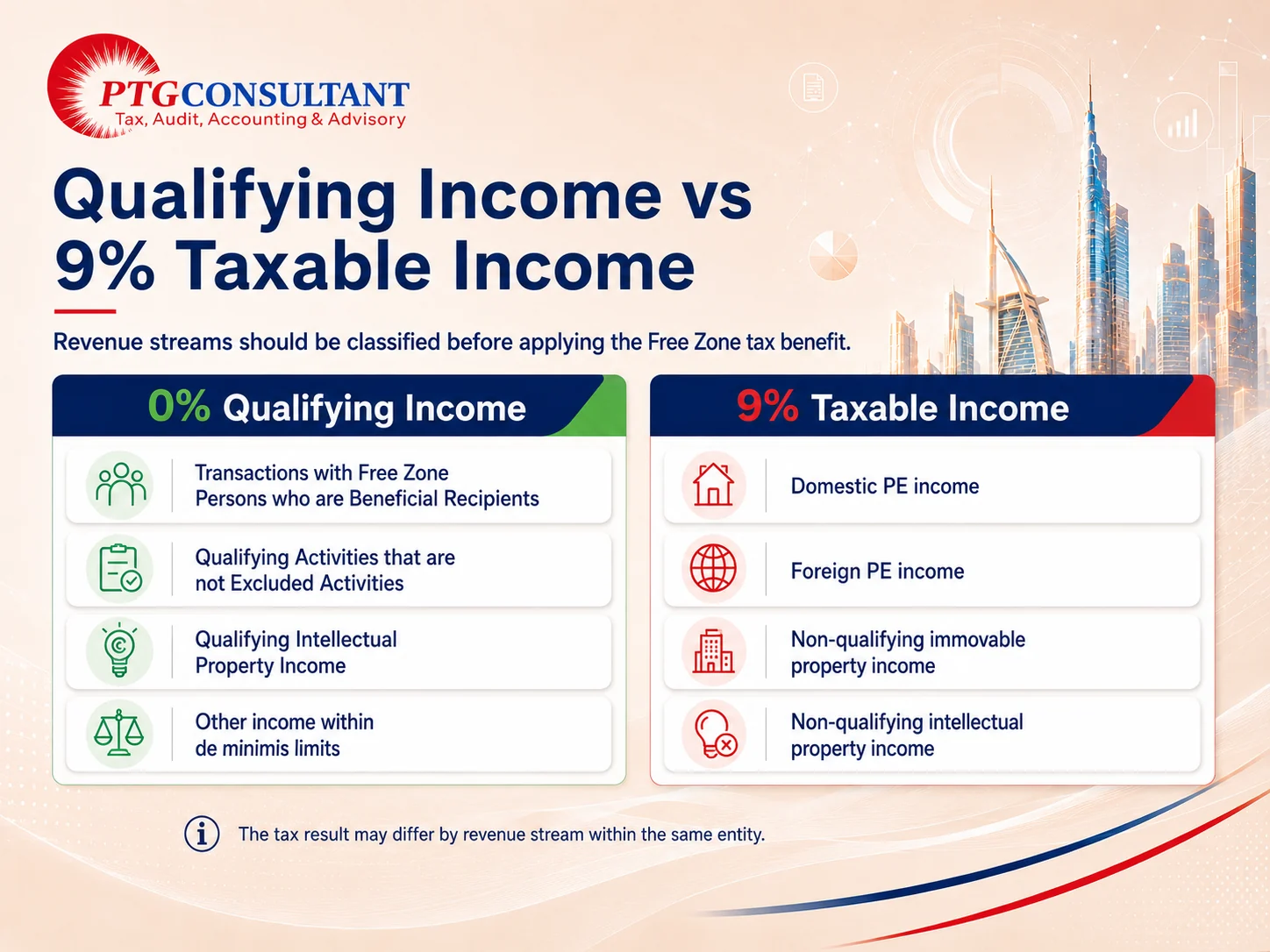
The FTA slides state that Qualifying Income may include income from transactions with Free Zone Persons where the recipient is the Beneficial Recipient and the transaction is not related to an Excluded Activity, income from Qualifying Activities that are not Excluded Activities, income from Qualifying Intellectual Property, and other income where de minimis requirements are met.
This means the 0% rate should not be applied globally to all revenue without classification.
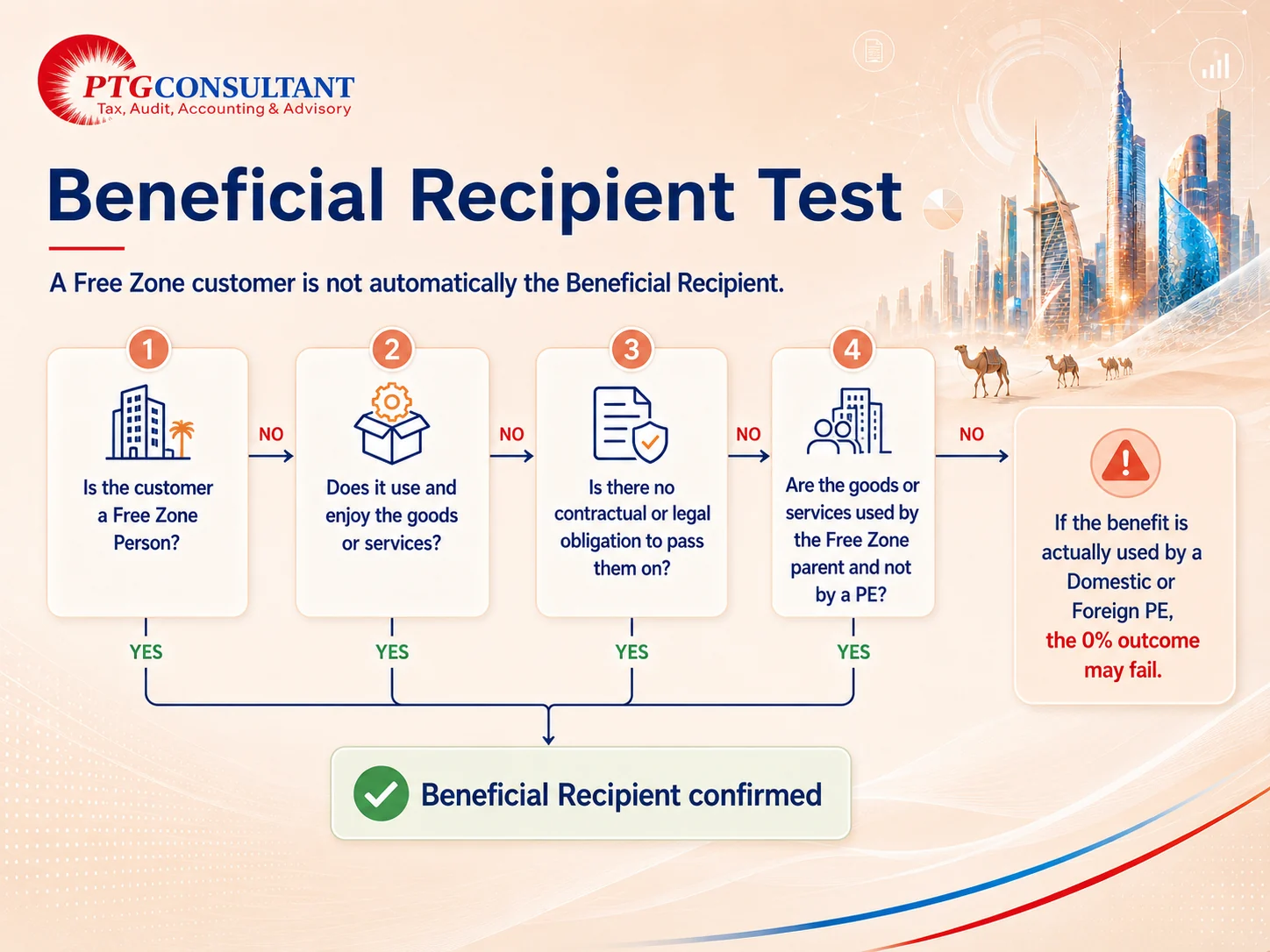
10. Beneficial Recipient test
The Beneficial Recipient test is one of the most important risk areas.
The FTA slides explain that, for transactions with another Free Zone Person, the recipient should have the right to use and enjoy the goods or services and should not have a contractual or legal obligation to supply them to another person. The goods or services must be for use by the Free Zone parent and not by a Domestic or Foreign Permanent Establishment. If the recipient is acting as an agent, conduit or intermediary, the third party is treated as the Beneficial Recipient.
Accordingly, an invoice issued to a Free Zone customer does not automatically create Qualifying Income.
The practical question is:
Who actually uses and enjoys the goods or services?
The FTA slides include an example where services are contracted with a Free Zone Person but delivered to that customer’s Domestic Permanent Establishment. In that case, the supplier is not treated as transacting with a Free Zone Person that is the Beneficial Recipient because the Domestic Permanent Establishment is treated as a Non-Free Zone Person for this purpose.
11. Domestic and Foreign Permanent Establishments
The FTA slides illustrate that a Free Zone Person may have a Free Zone parent, Domestic Permanent Establishment and Foreign Permanent Establishment within the same overall legal person. The Free Zone parent may be eligible for 0% on Qualifying Income, while Domestic and Foreign Permanent Establishments are not eligible for the 0% Corporate Tax rate and may be subject to 9% unless an exemption applies.
The slides also state that the 0% Corporate Tax rate applies only to the portion of the business in the Free Zone, while Domestic or Foreign Permanent Establishment income may be subject to 9% and may not benefit from certain reliefs.
This creates a practical need for branch-level attribution and transfer pricing support.
Activity classification
12. Qualifying Activities
The FTA slides list the Qualifying Activities under Ministerial Decision No. 229 of 2025, including:
- manufacturing of goods or materials;
- processing of goods or materials;
- trading of Qualifying Commodities;
- holding shares and securities for investment purposes;
- ownership, management and operation of ships;
- reinsurance services;
- fund management services;
- wealth and investment management services;
- headquarter services to Related Parties;
- treasury and financing services to Related Parties or for own account;
- financing and leasing of aircraft;
- distribution of goods or materials in or from a Designated Zone;
- logistics services.
A business should not rely only on the licence activity description. The actual activity, contracts, location, people, assets and income should support the tax classification.
13. Qualifying Commodities
The FTA slides highlight key updates for Qualifying Commodities, including the removal of the “raw form” requirement, introduction of additional commodities and derivatives, and recognised price reporting agencies under Ministerial Decision No. 230 of 2025.
The slides also state that trading of Qualifying Commodities may include physical trading, associated financial derivatives used to hedge trading risks, and associated structured commodity financing. However, this treatment does not apply where the QFZP derives 51% or more of its total revenue from distribution, warehousing, logistics or inventory management in the relevant tax period.
Commodity traders should maintain evidence around quoted price, commodity category, contracts, hedging arrangements, revenue split and substance.
14. Distribution of goods or materials
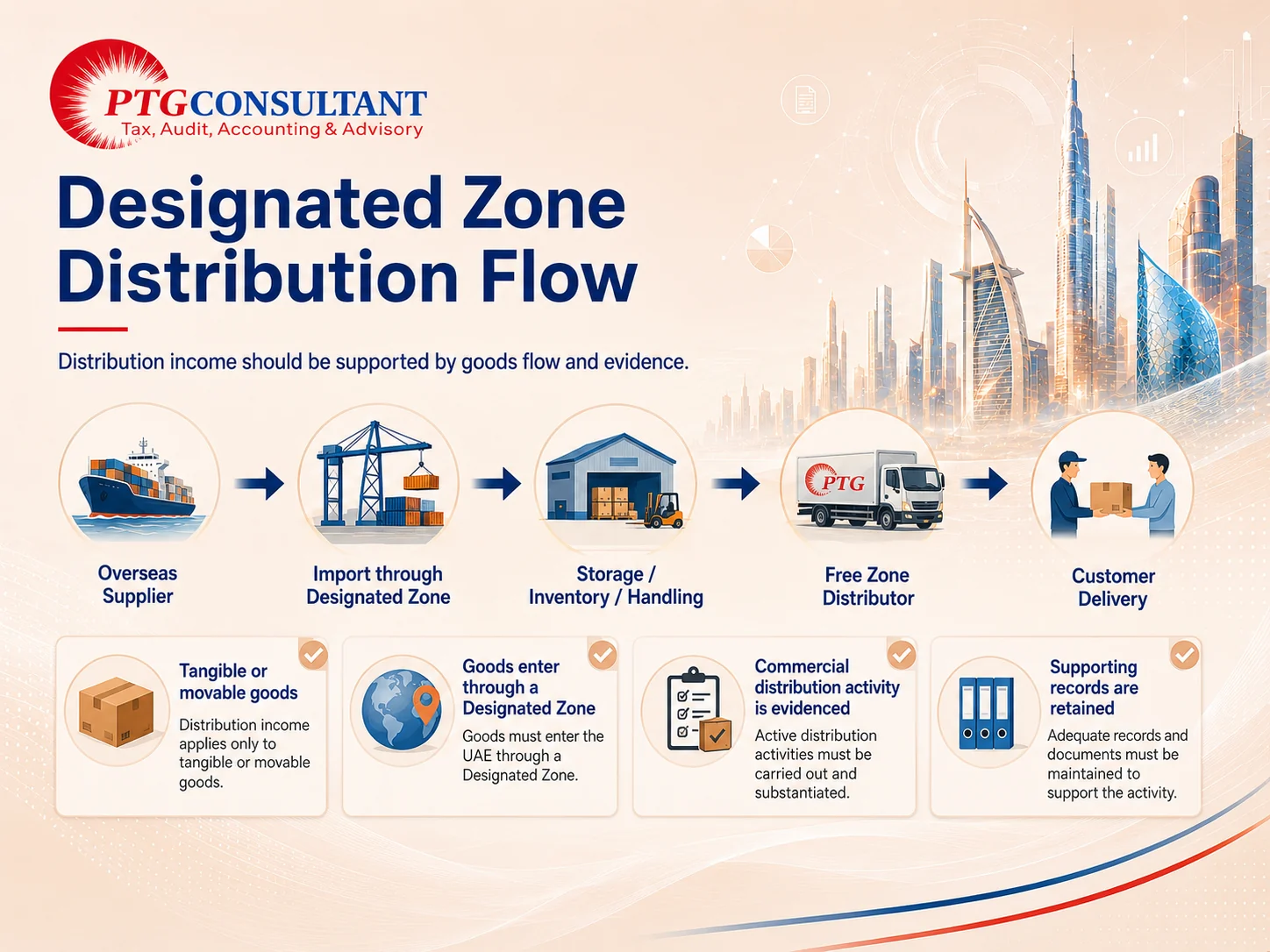
Distribution is a high-impact area for UAE Free Zone businesses.
The FTA slides state that distribution of goods or materials in or from a Designated Zone includes buying and selling tangible or movable goods, materials and component parts, and may include importation, storage, inventory management, handling, transportation and exportation. Where goods enter the UAE for distribution, they must be imported through a Designated Zone and physically pass through a Designated Zone.
The distributor must sell the goods or materials either to a person that resells, processes or alters them for sale or resale, or to a public benefit entity. The slides provide a practical example: a company buying laptops for employee use is not a reseller, while an electronics retailer selling laptops to other persons may be a reseller.
This means trading and distribution businesses should document goods flow, customer status and the customer’s intended use.
15. Excluded Activities
Some activities remain outside the 0% regime even where the company operates in a Free Zone.
The FTA slides refer to Excluded Activities under Ministerial Decision No. 229 of 2025, including certain transactions with natural persons, banking activities, insurance activities and ownership or exploitation of immovable property, subject to specific exceptions. The slides also state that Excluded Activities include ancillary activities where an activity is necessary for the performance of the main activity or makes a minor contribution and is closely related to the main activity.
This means a supporting activity may follow the tax character of an Excluded Activity.
Practical impact
16. Common risk areas for Free Zone businesses
Based on the FTA webinar framework, the most common risk areas are:
- assuming that a Free Zone licence automatically gives 0%;
- applying one tax conclusion to all revenue streams;
- treating every Free Zone customer as the Beneficial Recipient;
- ignoring mainland or foreign branches;
- not tracking non-qualifying revenue during the year;
- weak substance evidence;
- insufficient transfer pricing documentation;
- delay in preparing audited financial statements;
- weak evidence for distribution and Designated Zone goods flow;
- not maintaining records for the required period.
17. Compliance and reporting
A Free Zone Person remains a Taxable Person even where all income is Qualifying Income subject to Corporate Tax at 0%.
The FTA slides state that a Free Zone Person should obtain Corporate Tax registration within prescribed timelines unless exempt, pay Corporate Tax if applicable, file a Tax Return within nine months from the end of the relevant Tax Period, and maintain records and documents for seven years.
The slides also state that financial statements should be prepared based on accounting standards accepted in the UAE for Corporate Tax purposes, and audited financial statements are required regardless of revenue as a condition of being a QFZP.

Actions to consider
Free Zone businesses should consider the following actions before filing their Corporate Tax return:
- Confirm whether the entity is a Free Zone Person.
- Confirm whether the Free Zone or Designated Zone is recognised for Corporate Tax purposes.
- Prepare a revenue-stream classification matrix.
- Identify Qualifying Income and non-Qualifying Income.
- Review customer status and Beneficial Recipient evidence.
- Identify Domestic and Foreign Permanent Establishment exposure.
- Review Qualifying Activities and Excluded Activities.
- Monitor the de minimis threshold during the year.
- Prepare adequate substance evidence.
- Review transfer pricing documentation requirements.
- Maintain audited financial statements.
- Keep contracts, invoices, logistics records, customer confirmations and tax working papers.
- Maintain records for seven years.
- Complete the QFZP analysis before filing the Corporate Tax return.
How PTG Consultant L.L.C can support
PTG Consultant L.L.C can support UAE Free Zone businesses with:
- QFZP eligibility review;
- Free Zone and Designated Zone status assessment;
- Qualifying Income classification;
- Qualifying Activities and Excluded Activities review;
- Beneficial Recipient analysis;
- de minimis threshold calculation;
- Domestic and Foreign Permanent Establishment review;
- transfer pricing and FAR analysis;
- audited financial statement readiness;
- Corporate Tax return support;
- Free Zone Corporate Tax documentation file preparation.
Before assuming that Free Zone income qualifies for the 0% Corporate Tax rate, businesses should perform a technical QFZP review supported by facts, contracts, accounting records and operational evidence.
Request Free Zone Corporate Tax Review
Conclusion
The UAE Free Zone Corporate Tax regime remains an important relief for qualifying businesses, but it is not a blanket exemption.
The 0% Corporate Tax rate applies only where the Free Zone Person meets the QFZP conditions and the relevant income qualifies.
The key practical message is:
Do not test Free Zone Corporate Tax status only at licence level. Test it at revenue-stream level.
Businesses that assess entity status, activity classification, substance, Beneficial Recipient position, permanent establishment exposure, de minimis threshold, transfer pricing and audit readiness will be better positioned to support their Free Zone Corporate Tax position.
Official source basis
This article has been prepared with reference to:
- Federal Tax Authority Free Zone Corporate Tax webinar slides – August 2026;
- Ministerial Decision No. 229 of 2025 regarding Qualifying Activities and Excluded Activities;
- Ministerial Decision No. 230 of 2025 regarding recognised price reporting agencies;
- Ministerial Decision No. 336 of 2025 regarding Competent Authority specification;
- UAE Corporate Tax Law and related Free Zone Corporate Tax framework.
Disclaimer
This article is for general information only and should not be treated as legal, tax, accounting or regulatory advice. The UAE Free Zone Corporate Tax regime depends on the specific legal structure, licence, Free Zone status, activity, customer type, Beneficial Recipient position, substance, financial statements and documentation of each business. Professional advice should be obtained before determining QFZP status or filing a Corporate Tax return.