
Management fees, intra-group loans, brand royalties, group reorganisations and staff working across borders: these are the transactions that most often lead to transfer pricing questions from tax authorities. This guide explains how the arm's length principle in Article 34 of the UAE Corporate Tax Law applies to each of them, with UAE examples, the UAE-specific rules and real court cases.
1. Intra-group services: would a stranger pay?
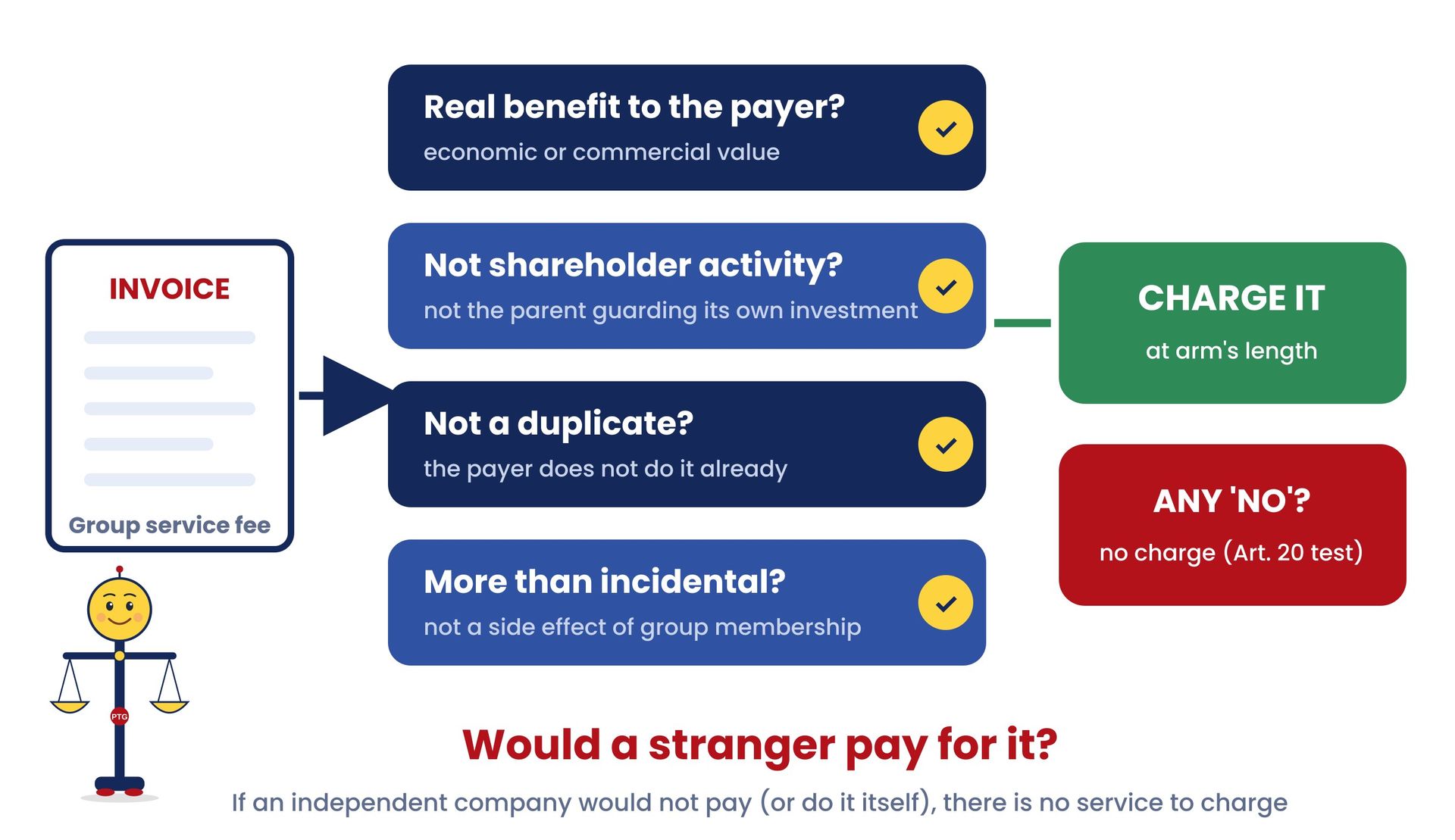
Before any charge is made, the benefit test applies: would an independent company pay for this activity, or do it itself? The FTA Transfer Pricing Guide (s.7.2.2) and the OECD Guidelines (Chapter VII) exclude three kinds of activity:
- Shareholder activities, such as the parent's own board meetings, consolidation or investor relations;
- Duplicates of work the subsidiary already does or buys;
- Incidental benefits that arise just from belonging to the group.
A charge that fails the benefit test can be adjusted in taxable income (Article 20). Pass-through costs are recharged at cost, and the hub's own work carries a mark-up.
The UAE cost + 5% option
The FTA guide (s.7.2.3.5) adopts the OECD simplified approach: low value-adding services can be charged at cost plus 5% without a benchmark, if they are supportive, not core, use no unique intangibles and involve no significant risk. R&D, manufacturing, sales and marketing, financial transactions and senior management never qualify.
| Abu Dhabi hub (illustrative) | AED |
|---|---|
| Payroll, finance and IT support (low value-adding) | 4,000,000 × 1.05 = 4,200,000 |
| Cloud licences, recharged at cost | 600,000 |
| Group strategy team (shareholder activity) | Not charged |
| Total charge, allocated by headcount | 4,800,000 |
2. Intra-group loans and guarantees: price the borrower, not the parent
First ask whether the advance is really a loan: is there a repayment date, binding interest and the capacity to repay? If not, part may be equity. Then build the rate: base rate (such as EIBOR or SOFR) plus a credit spread for the borrower's rating, reflecting the passive support of the group, adjusted for the terms.
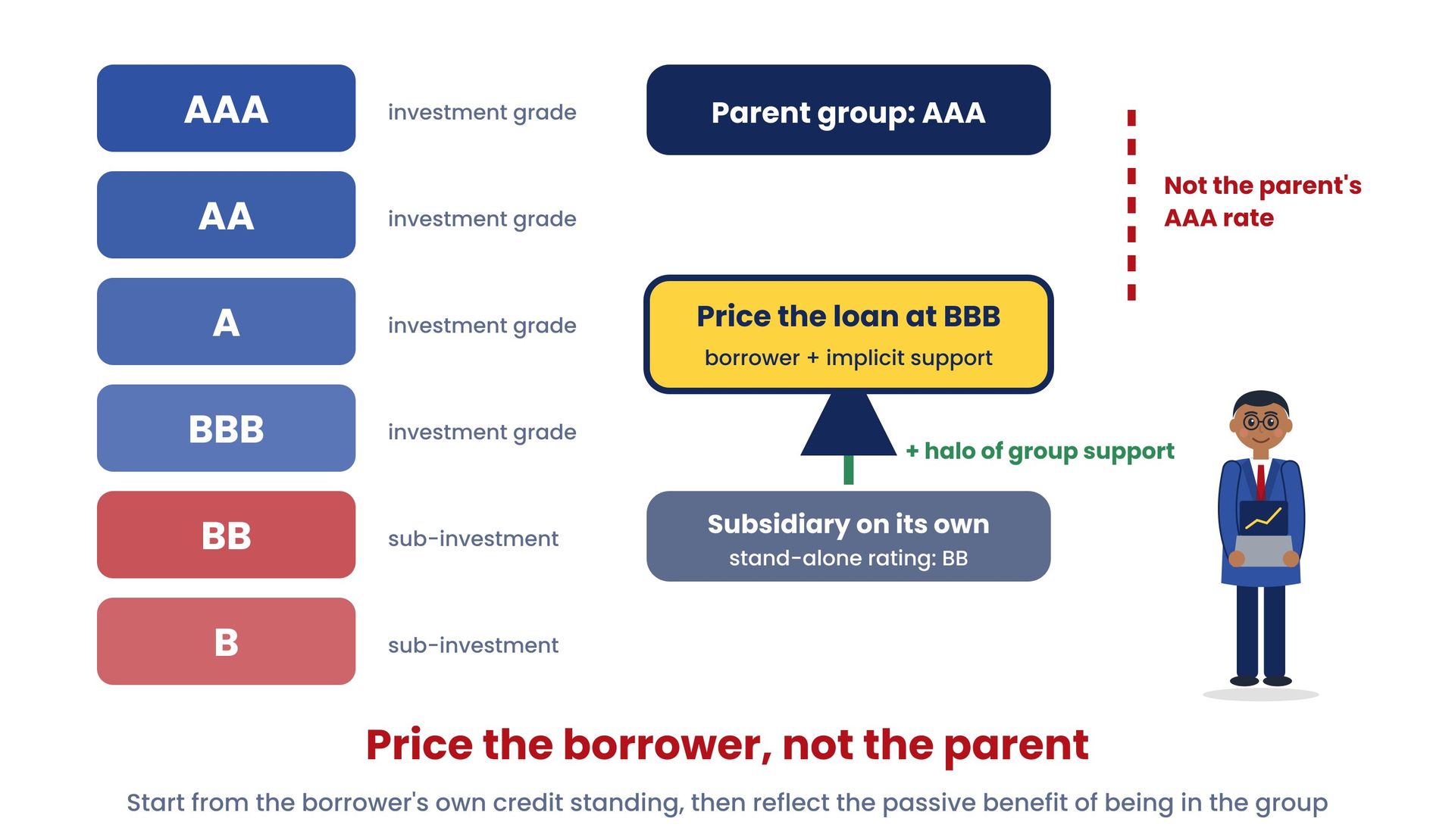
- A parent cannot charge for implicit support; an explicit guarantee justifies a fee only for the benefit above it.
- A cash pool leader with limited functions earns a service return; participants share the synergy.
- After transfer pricing, the UAE interest limits apply: Article 31 (specific) and Article 30 (net interest above 30% of adjusted EBITDA, or AED 12 million if higher, under Ministerial Decision No. 126 of 2023).
3. Intangibles: paper owns, people earn
Legal registration is only the starting point. Returns from intangibles follow the companies that perform and control DEMPE functions: development, enhancement, maintenance, protection and exploitation. A company that only funds development without controlling the financial risk earns no more than a risk-free return.
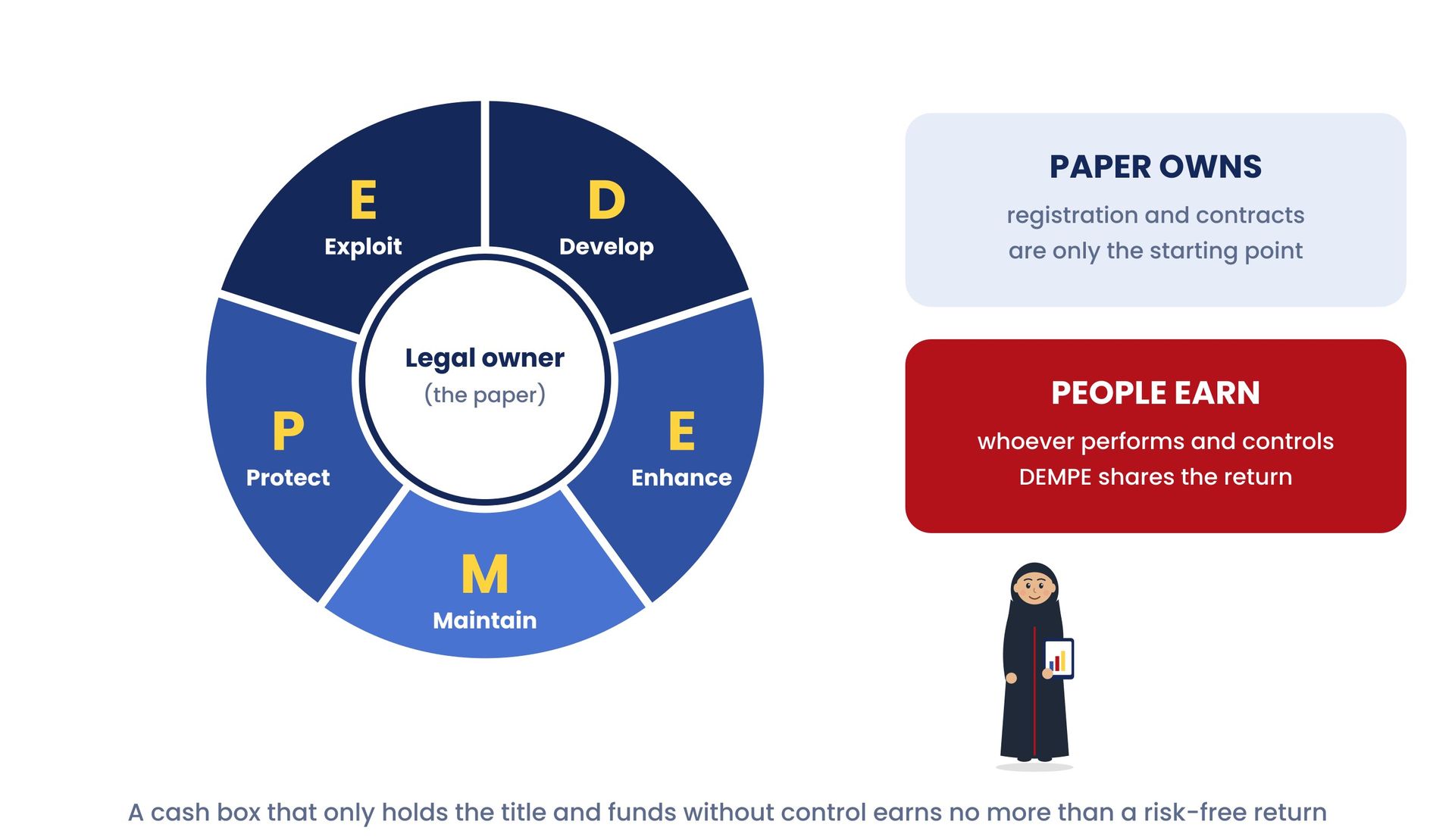
Illustration: a DIFC company with one director charges a Sharjah restaurant operator a 6% royalty, while the Sharjah team runs the menu, marketing and brand. The royalty is not arm's length. Hard-to-value intangibles, cost contribution arrangements and the Free Zone nexus approach for qualifying IP are covered in the course.
4. Business restructuring: something moved, who pays?
When functions, assets or risks move inside a group, for example a Saudi full-risk distributor becomes limited-risk and a Dubai principal takes over pricing and stock risk, ask what moved, why, whether the company giving it up would have agreed, and what an independent party would have been paid. Compensation follows what actually transfers or ends, not profit potential alone. The UAE reliefs in Articles 26 and 27 can help, subject to conditions and two-year clawbacks.
5. Permanent establishments: where do the people decide?
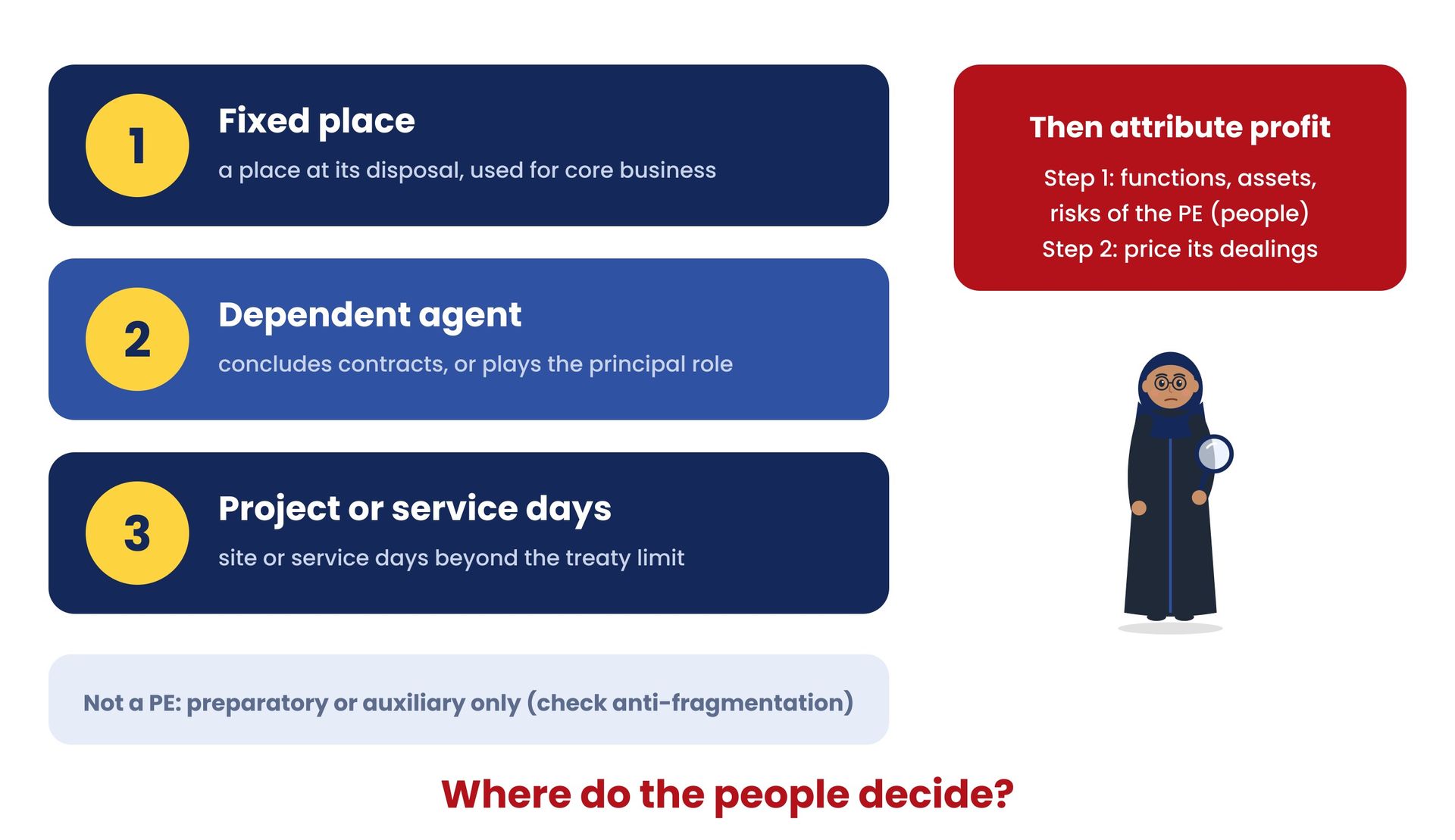
A foreign company is taxable in the UAE on profit attributable to a permanent establishment (Article 14): a fixed place at its disposal, a dependent agent who concludes contracts or plays the principal role, or a project beyond the treaty limit (12 months in the OECD Model, 6 in the UN Model). Profit is then attributed in two steps, following the people who perform the significant functions (FTA guide s.7.6.2).
6. What the courts say
- Italian Supreme Court, Judgment No. 5753/2026: a contract and invoices were not enough to deduct intra-group service charges; a real benefit had to be shown.
- Canada v General Electric Capital Canada (Federal Court of Appeal, 2010): implicit support counts, but a 1% guarantee fee was still arm's length.
- Chevron Australia Holdings v Commissioner (Full Federal Court, 2017): a high-rate, unsecured intra-group loan was priced above arm's length.
- Altera v Commissioner (US Ninth Circuit, 2019): stock-based compensation must be shared in cost sharing.
- Canada v Cameco (Federal Court of Appeal, 2020): real substance in the foreign trading company defeated recharacterisation.
- Formula One World Championship v CIT (Supreme Court of India, 2017): a circuit used for a few weeks a year was a fixed place PE.
Learn it properly: free PTG course, Module C
Module C of PTG's UAE Transfer Pricing Course has 10 short lessons with voiceover, a 12-question test after each lesson, six 60-second revision reels and a final exam with a PTG certificate and LinkedIn badge.
→ Start Module C free: services, financing, intangibles, restructuring and PEs
→ New to transfer pricing? Start with Module A and Module B.
→ Need help with management fees, loan pricing, DEMPE or a PE review? Book a consultation
Sources: Federal Decree-Law No. 47 of 2022 (Arts. 14, 20, 26, 27, 30, 31, 34); Ministerial Decision No. 126 of 2023; FTA Transfer Pricing Guide (CTGTP1) s.7.1–7.8; OECD Transfer Pricing Guidelines 2022, https://doi.org/10.1787/0e655865-en; OECD Model Tax Convention 2017; public court records. UAE examples are illustrative. General information, not tax advice.